Random Multiplier Slots: How Random Multipliers Work
Random multipliers are a simple idea with a lot of different implementations. The value might appear on a Multiplier symbol, arrive on a Wild, be drawn for a character or be revealed by an event. The random part tells you how the value is selected, not what happens to it next.
What are random multiplier slots?
A random multiplier is one whose value is selected from a defined random set. What matters is the value selection itself. An unpredictable result, a large multiplier or a multiplier carried by a Wild does not automatically make that multiplier random.
Gates of Olympus gives a clean example. Its Multiplier symbols take random values from a documented set spanning x2 to x500. The Dog House uses a much smaller set, with Multiplier Wilds carrying x2 or x3. Both use random values, but they carry and apply them differently.
How do random multipliers work?
In practice, the game defines the possible multiplier values, selects one of them at random, then applies that value according to its own scope and timing rules.
In Gates of Olympus, Multiplier symbols can appear during spins and tumbles and take random values from the documented x2 to x500 set. After the tumble sequence ends, the visible multiplier values are added together and the result multiplies the sequence win.
Tombstone R.I.P. uses a different model in Boothill Free Spins. Each spin draws a random Cowboy multiplier from a documented set spanning x5 to x999. That multiplier belongs to the selected Cowboy rather than acting as a general screen-wide multiplier, and a new one is drawn on the next spin.
The random part is the same. What changes is everything around it: what carries the value, what it applies to and when a new value is generated.
How is the random multiplier value selected?
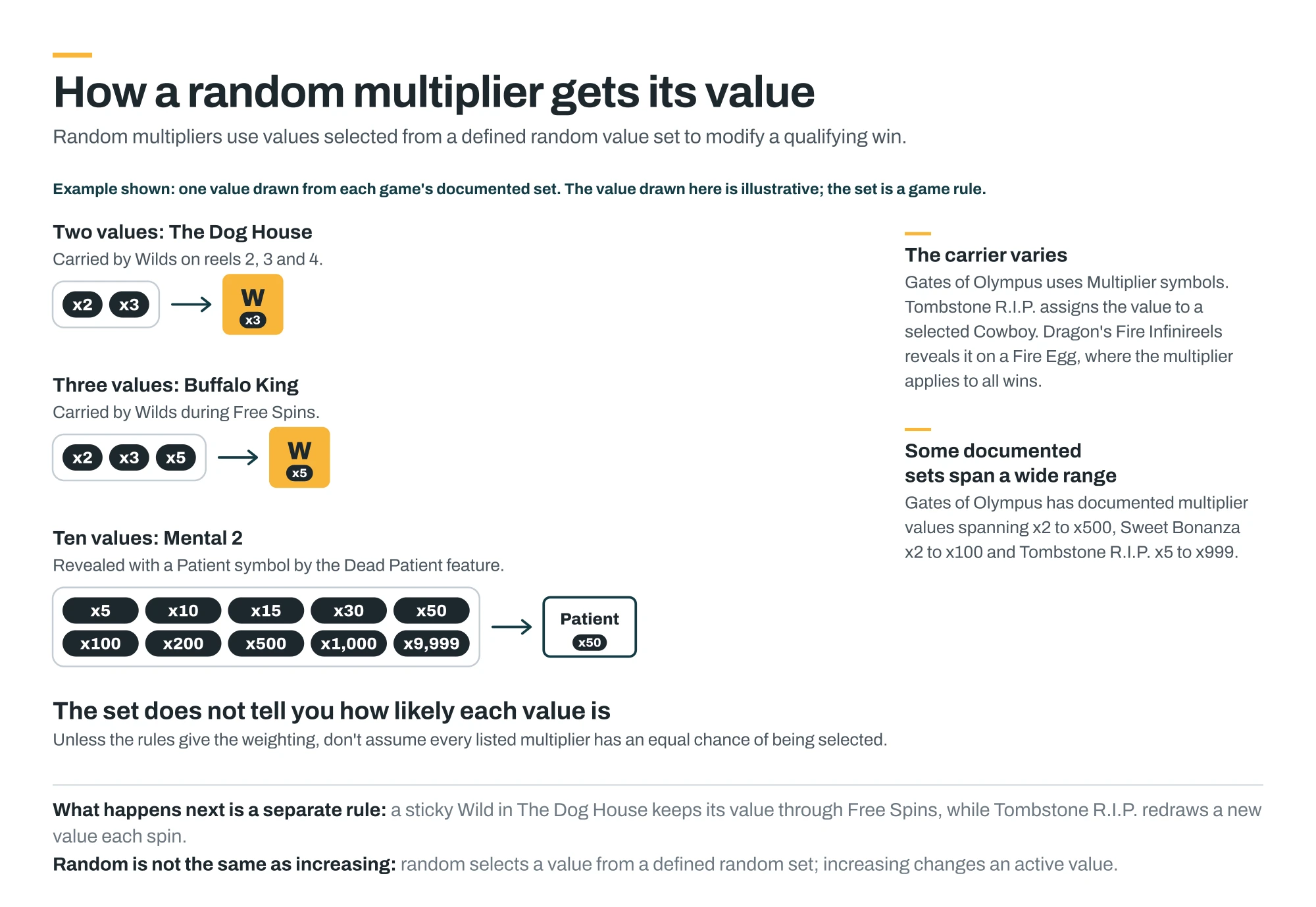
“Random” does not mean that any number can appear. The game rules define the possible multiplier values, and the random selection happens inside that set.
The Dog House uses x2 or x3 on its Multiplier Wilds. Buffalo King uses x2, x3 or x5 on Free Spins Wilds. Mental 2 has a much wider documented Dead Patient set: x5, x10, x15, x30, x50, x100, x200, x500, x1,000 or x9,999.
A published set does not tell you how likely each value is. Unless the rules give the weighting or probability for individual outcomes, you cannot assume that every listed multiplier has an equal chance of being selected.
The timing varies too. A value can be assigned when a Wild lands, drawn as part of a Free Spin, revealed by a symbol or produced by another game event. In Dragon’s Fire Infinireels, for example, a Fire Egg reveals the random multiplier instead of a conventional Multiplier symbol.
Where can a random multiplier appear?
A random multiplier does not have to appear in one particular form. The value can be carried in several different ways.
Multiplier symbols
Gates of Olympus and Sweet Bonanza both use dedicated Multiplier symbols. Gates can use them during the base-game spin and tumble sequence, while Sweet Bonanza’s Multiplier symbols appear only during Free Spins in the reviewed rules.
Multiplier Wilds
The Dog House and Buffalo King attach random multiplier values to Wilds. That makes them Multiplier Wilds, but “Multiplier Wild” describes the carrier. The fact that the value itself is selected randomly is a separate rule.
Selected symbols or characters
In Tombstone R.I.P., the Boothill feature draws a random Cowboy multiplier for the selected Cowboy on each spin. Mental 2 uses Dead Patients to reveal a Patient symbol with a random multiplier from its documented set.
Events and feature objects
Dragon’s Fire Infinireels uses a Fire Egg. When one appears, it reveals a random multiplier that applies to all wins. The random value is therefore generated by a game event rather than by a standard Wild or Multiplier symbol.
What does a random multiplier apply to?
Once a value has been selected, the game still has to decide what it affects. That might be one payline, one symbol, the current tumble sequence or every qualifying win.
The Dog House applies its Wild multiplier to a winning payline in which that Wild participates. Buffalo King applies participating Wild multipliers to the winning combination containing those Wilds. Tombstone R.I.P. narrows the scope to the selected Cowboy, while Dragon’s Fire Infinireels uses a Fire Egg multiplier that applies to all wins.
Gates of Olympus and Sweet Bonanza apply their combined Multiplier symbol value to the current tumble sequence’s win.
How long does a random multiplier last?
Random selection does not tell you how long the value lasts. It might disappear after the current line or spin, remain through a tumble sequence or stay attached to a persistent symbol or feature state.
In Sweet Bonanza, Multiplier symbols remain for the current tumble sequence and a new Free Spin starts a new multiplier-symbol state. Tombstone R.I.P. redraws its Boothill Cowboy multiplier each spin.
In The Dog House, the value can last much longer during Free Spins. A Wild that becomes sticky keeps the x2 or x3 multiplier assigned when it landed until the final Free Spin. The value was selected randomly, but keeping it in place is a separate rule.
Mental 2 takes that separation further. Its Dead Patient feature can generate a random multiplier, while related Surgery rules can store the highest Dead Patient multiplier for a Patient type and transfer it to later matching symbols. The random draw and the later storage system are different parts of the game.
What happens when more than one random multiplier applies?
There is no universal combination rule. Multiple values might be added, multiplied or handled in another game-specific way.
The Dog House adds the multiplier values from multiple participating Wilds on the same winning payline. Two Wilds carrying x2 and x3 therefore contribute x5 under that rule. Buffalo King works differently: participating Wild multipliers are multiplied together, so an x2 and an x3 Wild produce x6 for that winning combination.
Gates of Olympus and Sweet Bonanza also use addition, but in a different context. The visible Multiplier symbol values are summed at the end of the relevant tumble sequence before the combined value is applied.
Random Multipliers vs Increasing Multipliers
Increasing Multipliers and random multipliers answer different questions.
Random describes how a multiplier value is selected. Increasing describes how an active multiplier state changes after qualifying events. A multiplier can be random without increasing, increasing without random selection, or use random generation as one part of a larger persistent or progressive system.
The Dog House makes the distinction clear. Its Wild receives a random x2 or x3 value when it lands. During Free Spins that assigned value can persist because the Wild becomes sticky, but it does not need to increase for the value itself to remain a random multiplier.
Random Multipliers vs fixed multipliers
A fixed or predetermined multiplier uses a value set by the relevant rule rather than selecting that value randomly from a set.
If a feature always applies x2 under the same condition, the multiplier may still matter to the game, but it is not a random multiplier under this definition. The uncertainty of the spin result does not make the multiplier value itself random.
So “random multiplier” describes how the value is generated, not simply an outcome you could not predict before the spin.
Random Multipliers vs Multiplier Wilds
A Multiplier Wild describes a Wild that carries or applies a multiplier. A random multiplier describes how the multiplier value is selected.
The Dog House and Buffalo King combine the two ideas because their Wilds carry random multiplier values. That does not mean every Multiplier Wild is random, and it does not mean every random multiplier is carried by a Wild. Gates of Olympus uses Multiplier symbols, Tombstone R.I.P. assigns a multiplier to a selected Cowboy, and Dragon’s Fire Infinireels uses a Fire Egg event.
Random multiplier examples compared
| Game | Carrier / trigger | Random value | Scope, combination or lifetime |
|---|---|---|---|
| Gates of Olympus | Multiplier symbols during spins and tumbles. | Documented set spanning x2 to x500. | Visible values add after the tumble sequence and apply to that sequence’s win. |
| The Dog House | Wilds on reels 2, 3 and 4. | x2 or x3. | Participating Wild values add on the winning payline; sticky Free Spins Wilds keep the assigned value. |
| Buffalo King | Wilds during Free Spins. | x2, x3 or x5. | Participating Wild multipliers multiply together for the winning combination. |
| Sweet Bonanza | Multiplier symbols during Free Spins. | Documented set spanning x2 to x100. | Visible values add at tumble end; state belongs to the current tumble sequence. |
| Tombstone R.I.P. | Boothill Cowboy multiplier drawn each Free Spin. | Documented set spanning x5 to x999. | Applies to the selected Cowboy and is redrawn on the next spin. |
| Mental 2 | Dead Patient feature reveals a Patient multiplier. | Defined set from x5 to x9,999. | Later storage and transfer can occur under separate Dead Multiplier rules. |
| Dragon’s Fire Infinireels | Fire Egg. | Random multiplier; exact value set is not stated in the evidence used here. | Applies to all wins; only one Fire Egg may land per spin. |
What the Random Multiplier label does not tell you
Knowing that a slot uses random multipliers still leaves plenty unanswered: which values are possible, whether those values are equally likely, what carries the multiplier, what it applies to, how several values combine and how long a selected value remains active.
The label also tells you nothing by itself about RTP, volatility, hit frequency, feature frequency, maximum win or the likelihood of winning. Larger possible multiplier values are not evidence that a game is more likely to pay or offers better value.
Cascading Reels, Free Spins and Sticky Wilds can all provide the setting for a random multiplier without defining how that value is selected.
Random Multipliers FAQ
What are random multiplier slots?
They are slots where a multiplier value is selected from a defined random set, then applied according to the game’s own scope and timing rules.
How do random multipliers work in slots?
The game selects a multiplier value from its defined random value set, then applies that value to a qualifying win, symbol, combination, sequence or other defined target.
How are random multiplier values selected?
There is no single method. A value might be assigned when a Wild lands, carried by a Multiplier symbol, drawn for a selected character or revealed by an event such as a Fire Egg.
Are all random multiplier values equally likely?
Not necessarily. A list of possible multiplier values does not tell you the probability or weighting of each outcome. Equal likelihood should only be stated if the game’s evidence actually establishes it.
Do random multipliers only appear in bonus rounds?
No. Gates of Olympus uses random Multiplier symbols in the base game, while other reviewed examples such as Sweet Bonanza and Buffalo King use their random multiplier behaviour during Free Spins.
What can a random multiplier apply to?
It may apply to a payline, one winning combination, a selected symbol, a tumble sequence, all wins or another qualifying event defined by the rules.
Can multiple random multipliers be added or multiplied together?
Yes, depending on the game. The Dog House adds participating Wild multiplier values on the same payline, while Buffalo King multiplies participating Wild multipliers together.
Do random multipliers persist between spins or Free Spins?
They can, but persistence is a separate rule. In The Dog House Free Spins, a sticky Wild keeps the random x2 or x3 value assigned when it landed until the feature ends. Other random values may last only for one spin or tumble sequence.
What is the difference between random and increasing multipliers?
Random describes how the multiplier value is selected from a defined random set. Increasing describes how an active multiplier value progresses after qualifying events. A game can use one behaviour, the other or both.
Is a random multiplier the same as a Multiplier Wild?
No. Random describes value selection, while Multiplier Wild describes the symbol carrying or applying the multiplier. A Multiplier Wild may have a random value, but random multipliers can also be carried by other symbols, selected characters or feature events.
Sources reviewed
The examples on this page were checked against primary material wherever possible. Linked game names below lead to the software provider’s public game page where one was available. The evidence reviewed may also include in-game rules, developer game sheets and authenticated developer material that is not publicly accessible.
Pragmatic Play
Nolimit City
Red Tiger
How we research slot mechanics
Slotathon starts with primary evidence such as game rules, in-game help, developer documentation and game sheets. Third-party reviews are used as secondary sources to compare against that evidence and help identify areas that may need further verification.
When sources disagree, we preserve the disagreement in the research instead of quietly choosing whichever version is easiest to publish.