
Cascading Reels Slots: How Cascades, Tumbles & Avalanches Work
Cascading Reels let one win lead straight into another chance for a win. Winning symbols are removed, replacements enter and the new arrangement is checked again, all within the same spin or game round.
Quick answerIn a Cascading Reels slot, the symbols involved in a qualifying win are removed and replacement symbols enter. The game then checks the new screen again within the same spin or round. If another win forms, the sequence can repeat. The payout system can still be paylines, Ways, Cluster Pays or Pay Anywhere.
What are Cascading Reels?
Cascading Reels change the screen after a qualifying win. The winning symbols are removed or cleared, other symbols may move into the gaps, and replacements enter. The game then checks the new arrangement for another win.
If the refill creates another win, the process can happen again. That chain is the cascade.
The important point is that the cascade belongs to the same spin or game round. It is not a new paid spin just because a fresh set of symbols has appeared.
How do Cascading Reels work?
The basic loop is simple: win, remove, refill, re-evaluate.
Gates of Olympus calls this its Tumble Feature. When regular paying symbols form a win, those symbols disappear, the remaining symbols fall down, new symbols enter from above and the screen is evaluated again. The sequence continues while new regular-symbol wins keep appearing.
Gonzo’s Quest uses the name Avalanche. A winning bet line is paid, the winning symbols are removed, new symbols fall into the vacated positions and the new screen is checked without another stake being placed.
Reactoonz applies the same remove-and-refill loop to cluster wins on a 7×7 grid: winning symbols are removed, new symbols fall into the gaps, and the grid is checked again.
The wins created during the chain still count. In Gonzo’s Quest, the win is added before the winning symbols are removed for the next Avalanche. How a game displays or totals wins across the full sequence is a game rule rather than part of the Cascading Reels definition.
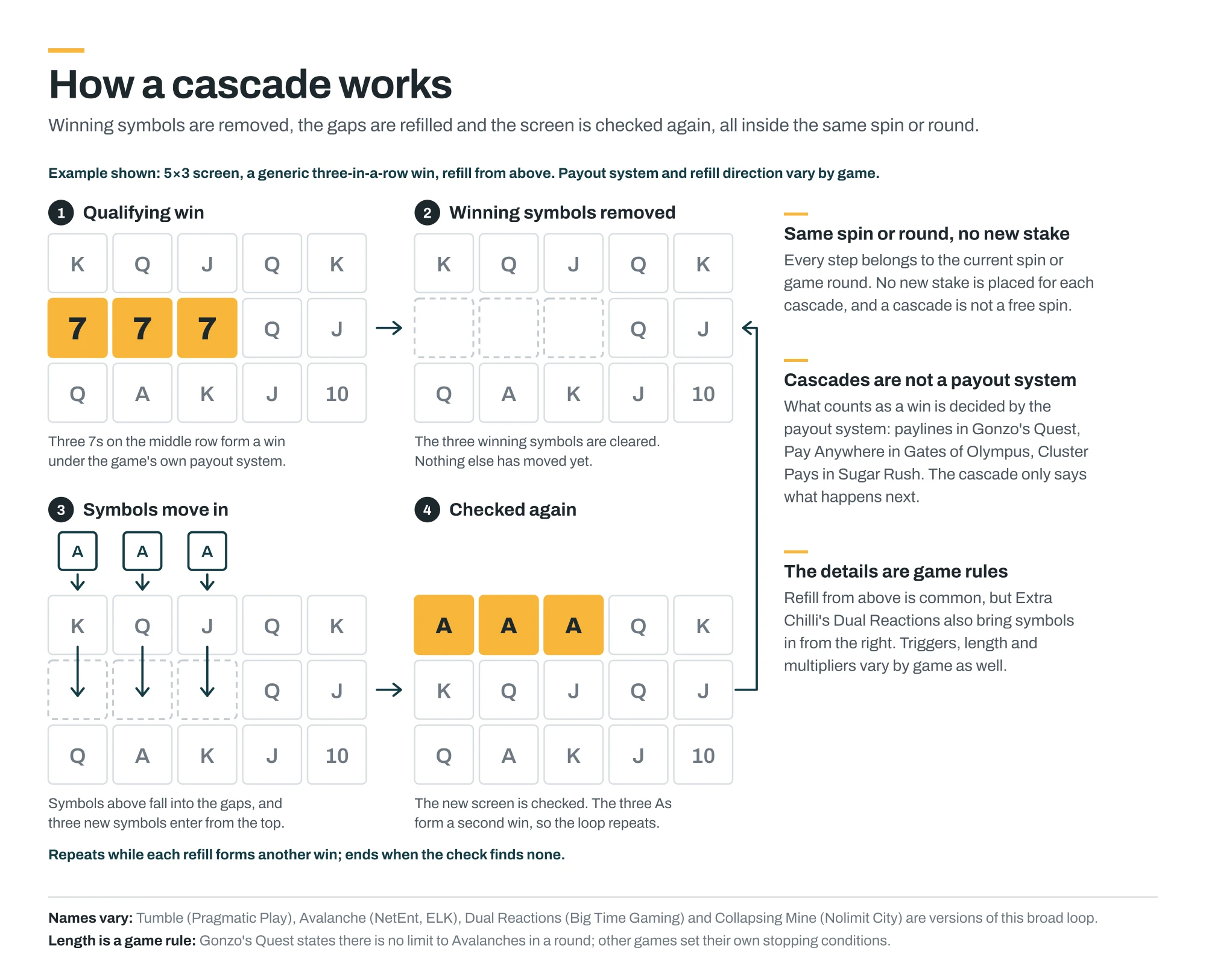
The names and payout systems are different, but the same broad loop is there: remove the winning symbols, refill the gaps and check again.
What starts a cascade?
Usually, a qualifying win starts the sequence. Even then, not every paying event has to trigger one.
In Gates of Olympus, regular-symbol wins start the Tumble sequence. Its Scatter symbol follows a separate rule for triggering Free Spins, so the game itself decides which results feed into the cascade.
Some games also use the same collapse-and-refill behaviour for feature effects. Fire in the Hole 2 calls its version the Collapsing Mine. A collapse can follow an ordinary winning combination, but xBomb Wild explosions and Wild Mining can trigger it too.
A win is therefore the common starting point, but not an absolute rule for every implementation.
Cascade, Tumble and Avalanche: are they the same thing?
They describe the same broad family of behaviour, but the names do not guarantee identical rules.
Pragmatic Play uses Tumble in games such as Gates of Olympus and Sugar Rush. NetEnt uses Avalanche in Gonzo’s Quest, while ELK uses Avalanche in Katmandu Gold. Big Time Gaming’s Dual Reactions and Nolimit City’s Collapsing Mine are other examples of provider or game-specific terminology.
The label matters less than what actually happens. Are symbols cleared, are replacements brought in, and is the new arrangement checked again without starting a fresh paid spin?
Trigger rules, refill direction and extra effects can all vary around that basic loop.
Do cascades always fall from the top?
No. A downward refill from above is common, but it is not part of the definition.
Gates of Olympus and Sugar Rush both refill vertically: symbols above the cleared positions drop into the gaps and new symbols enter from the top.
Extra Chilli does it differently. Its Dual Reactions can bring symbols in from the top and from the right, while the extra reel below the main reels moves right-to-left and feeds additional symbols upward.
So “new symbols fall from above” describes many cascading slots, but not the mechanic as a whole.
How long can a cascade sequence continue?
In many games, the sequence keeps going while each refill creates another qualifying win. When the next evaluation produces no further win, the cascade ends.
The maximum number of cascades is game-specific. Gonzo’s Quest explicitly states that there is no limit to the number of Avalanches that can occur in a game round. Gates of Olympus also continues tumbling while new regular-symbol wins are formed, with no tumble-count cap stated in the reviewed UK rules.
That does not make unlimited cascades a general rule. Each game sets its own stopping conditions.
Cascading Reels are not a payout system
This distinction is easy to miss because cascades are often discussed alongside the way a game forms wins. They answer a different question.
A payout system decides what counts as a win. Cascading Reels describe what happens after a qualifying result has been resolved.
| Game | Payout system | Cascade label | What the example shows |
|---|---|---|---|
| Gonzo’s Quest | 20 fixed paylines | Avalanche | A fixed-payline win can feed directly into a cascade sequence. |
| Gates of Olympus | Pay Anywhere | Tumble | Count-anywhere regular-symbol wins can trigger repeated replacement. |
| Sugar Rush | Cluster Pays | Tumble | A connected cluster can be the win that starts the replacement loop. |
| Extra Chilli | Megaways / Ways | Dual Reactions | A Ways-style game can use cascades with a different refill direction. |
A cascade is therefore not shorthand for Cluster Pays, Megaways or any other payout model. The mechanics can coexist, but one does not define the other.
Cascades and increasing multipliers
Cascade sequences are sometimes paired with multipliers that grow as the chain continues. That interaction can make the cascade feel like it is “building”, but the multiplier is a separate rule.
In Gonzo’s Quest, the win multiplier rises with successive Avalanches, using a documented x1 to x5 range in the main game and x3 to x15 during Free Falls.
Cascades can also run inside a free-spin feature. In Gonzo’s Quest, Free Falls still use Avalanches; the Free Fall is the enclosing free spin, while the Avalanche is the remove-and-refill sequence that can happen within it.
Other cascading games can handle multipliers differently or not increase one at all. If you want the multiplier behaviour itself, see Increasing Multipliers.
Cascading Reels vs reel expansion
Replacing symbols is not the same thing as making the playable area larger.
In a normal cascade, winning positions are cleared and refilled within the existing play area. An Expanding Reels mechanic changes the structure itself by adding playable rows, reel positions or other space.
Some games combine the two. In Fire in the Hole 2, each collapse activates another row, taking the game from three active rows up to six. In Katmandu Gold, winning symbols explode and replacements drop in while the Avalanche can also add rows, up to eight during the sequence.
That growth belongs to a separate mechanic: win-driven reel expansion. The cascade explains the removal and replacement. The expansion explains why the playable structure is getting larger.
What Cascading Reels do not tell you
Knowing that a slot uses cascades tells you how the game can continue after a qualifying result. It does not tell you how often that will happen or how the game is tuned overall.
Cascading Reels alone do not establish:
- RTP;
- volatility;
- hit frequency;
- maximum win;
- whether the game uses Cluster Pays, Ways, paylines or Pay Anywhere;
- whether a multiplier increases during the cascade;
- how likely a player is to win.
None of those properties follows from the presence of cascades alone. A cascade is a sequence rule, not a shortcut to the rest of the game’s mathematics.
Cascading Reels FAQ
What are cascading reels in slots?
Cascading Reels remove symbols involved in a qualifying result, bring replacement symbols into the vacated positions and evaluate the new arrangement again within the same spin or round. The sequence can repeat if another win forms.
Are cascading reels the same as tumbling reels?
Tumble is one of the names developers use for the same broad replacement family. The exact trigger, refill direction, exclusions and extra effects still depend on the individual game.
What is an Avalanche in slots?
Avalanche is a developer term used for cascade-style behaviour in games including Gonzo’s Quest and ELK’s Katmandu Gold. Winning symbols are cleared, replacements enter and the new arrangement can be evaluated again.
Is a cascade the same as a free spin?
No. A cascade is a continuation of the current spin or game round after a qualifying result. A free spin is a separate awarded spin with its own feature rules.
Do cascading reels always use Cluster Pays?
No. Sugar Rush combines Cluster Pays with Tumbles, but Gonzo’s Quest combines fixed paylines with Avalanches and Gates of Olympus combines Pay Anywhere with Tumbles.
Do all cascades fall from the top?
No. Top-down refill is common, but Extra Chilli’s Dual Reactions also bring symbols in from the right. Refill direction is game-specific.
How many cascades can happen from one spin?
It depends on the game. Gonzo’s Quest explicitly states that there is no limit to the number of Avalanches in a game round, but that should not be treated as a rule for every cascading slot.
Do cascading reels always have increasing multipliers?
No. Some games link multiplier growth to continuing cascades, including Gonzo’s Quest, but an increasing multiplier is not part of the Cascading Reels definition.
Can a cascade expand the grid?
Yes, in some games. Fire in the Hole 2 and Katmandu Gold both combine cascade-style replacement with row growth. The expansion is a separate mechanic layered onto the cascade.
Sources reviewed
The examples on this page were checked against primary material wherever possible. Linked game names below lead to the software provider’s public game page where one was available. The evidence reviewed may also include in-game rules, developer game sheets and authenticated developer material that is not publicly accessible.
Big Time Gaming
ELK Studios
NetEnt
Nolimit City
Pragmatic Play
How we research slot mechanics
Slotathon starts with primary evidence such as game rules, in-game help, developer documentation and game sheets. Third-party reviews are used as secondary sources to compare against that evidence and help identify areas that may need further verification.
When sources disagree, we preserve the disagreement in the research instead of quietly choosing whichever version is easiest to publish.