
Bonus Feature Selection in Slots: How Choose-Your-Bonus Features Work
Some slot bonuses begin with a choice. Instead of the game deciding every detail for you, it presents two or more feature paths and asks which one you want to play. That part is simple. The interesting bit is what your decision changes once the bonus starts.
What is Bonus Feature Selection in slots?
Bonus Feature Selection is what happens when a slot lets the player decide how a bonus will run. Once the bonus is ready to begin, the game presents two or more defined options and the player’s selection determines the rules that follow.
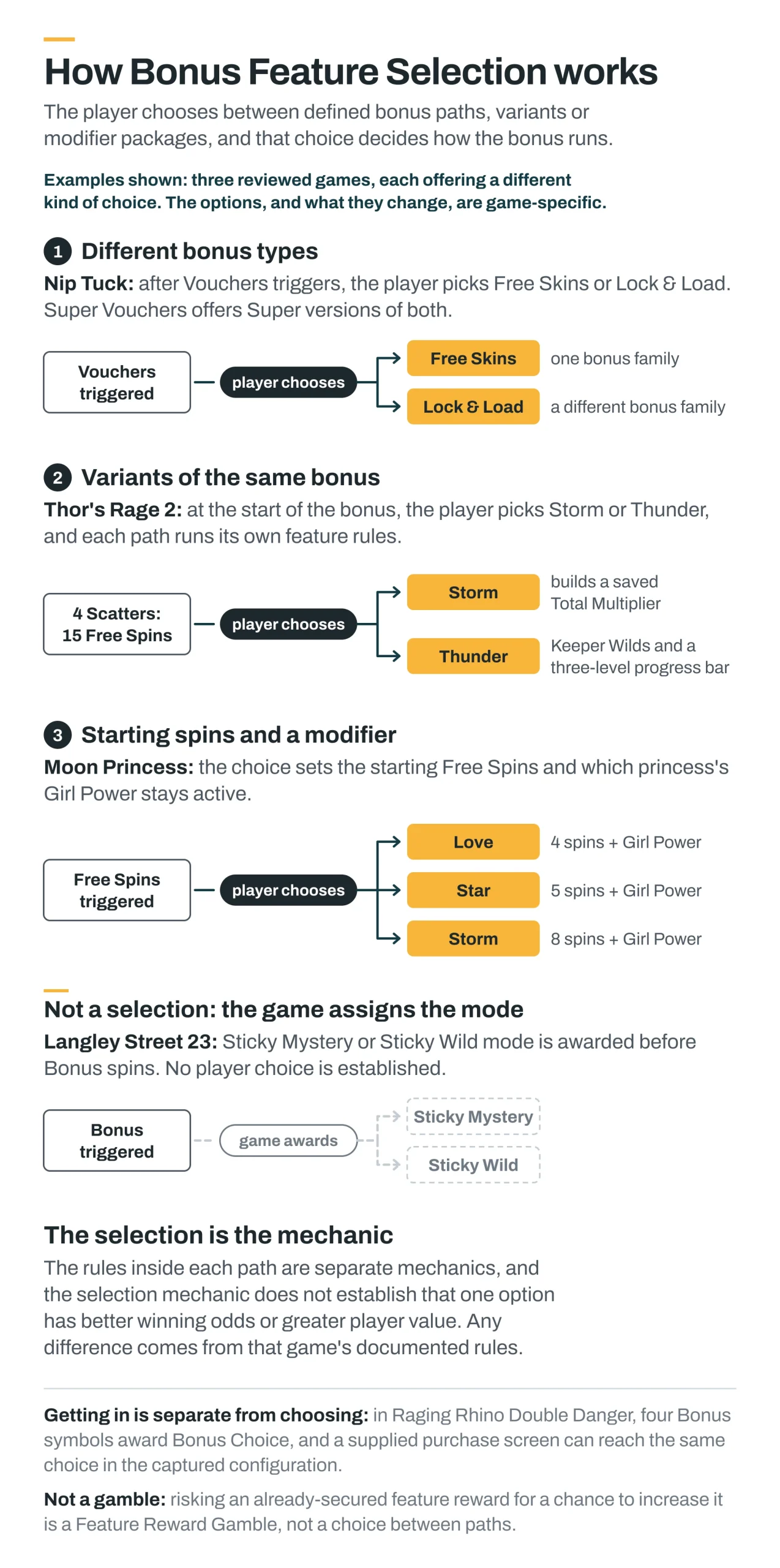
Moon Princess shows the idea neatly. When its Free Spins feature begins, the player chooses Love, Star or Storm. That decision changes the starting number of Free Spins and decides which princess’s Girl Power stays active during the feature. Nip Tuck goes further: its Vouchers feature lets the player choose between Free Skins and Lock & Load, which are different bonus paths rather than two versions of the same setting.
How do choose-your-bonus features work?
The sequence is straightforward: the game reaches a bonus or access condition, presents a set of defined options, the player chooses one, and that selection controls what happens next.
What happens after the choice is where the games start to diverge. In Moon Princess, the selection changes both the starting Free Spins count and the active Girl Power. In Thor’s Rage 2, the player chooses between Storm and Thunder bonus paths. In HelioPOPolis, the choice is between two modifier packages for the upcoming Free Spins: Synced Reels with huge-symbol potential, or Expanded Win Symbol with guaranteed Wilds.
So a “choose your bonus” screen does not point to one standard trade-off. Depending on the game, you might be choosing a feature family, a modifier package, a starting structure or some combination of them.
When does the player make a bonus choice?
In the games reviewed here, the choice appears once the game has established that a bonus is about to begin. How it reaches that point is game-specific.
In Moon Princess, clearing the full 25-symbol grid triggers Free Spins and the princess choice appears at entry. In Nip Tuck, the Vouchers or Super Vouchers trigger is established first, then the player chooses which bonus path to take. Raging Rhino Double Danger uses a named Bonus Choice state: current first-party evidence confirms that four Bonus symbols award that choice, and a supplied purchase screen can also enter the same Bonus Choice where that paid-access configuration is available.
Raging Rhino makes an important distinction clear: getting into the bonus and choosing what happens inside it are separate things. Reaching a bonus naturally, buying access in a permitted configuration or using another documented route does not change what Bonus Feature Selection means. The mechanic begins when the game presents alternatives for the player to select.
What can players choose between?
There are three useful ways this can play out, and some games sit across more than one of them.
Different bonus types
Nip Tuck lets the player choose Free Skins or Lock & Load after triggering Vouchers. Its Super Vouchers state similarly offers Super Free Skins or Super Lock & Load. Here the choice sends the game into different bonus families rather than merely adjusting one setting inside a shared feature. The names are specific to Nip Tuck, but the structure is not: one qualifying state, two named destinations and a player decision between them.
Different variants of the same broad bonus
Thor’s Rage 2 asks the player to choose Storm or Thunder at the start of the bonus. Both sit inside the game’s Free Spins or Super Free Spins framework, but the selected path determines the bonus mechanics that follow. That choice is separate from the Free Spins mechanic itself: Free Spins describe the awarded spin sequence, while Storm or Thunder decides which feature rules operate inside it.
Different modifier packages or starting structures
Moon Princess keeps the choice inside Free Spins but changes the setup: Love starts with 4 spins, Star with 5 and Storm with 8, while the chosen princess’s Girl Power remains active throughout the selected feature. So you are not simply picking a number of spins: the starting count and the feature behaviour are both tied to the selected princess.
HelioPOPolis likewise keeps the choice tied to Free Spins but lets the player select between Synced Reels and Expanded Win Symbol behaviour. The supplied HelioPOPolis build also contains paid bonus access, but that is a separate mechanic and does not establish paid access in other jurisdictions.
None of those patterns is a universal template. What matters is that the game presents genuine alternatives and the player actively decides which rules will apply next. Broad rules such as “one option gives more spins while another gives bigger multipliers” are unreliable; each game divides its choices in its own way.
Bonus Feature Selection vs random or automatic assignment
A bonus can have several possible modes without giving the player any say in which one appears. That difference matters.
Langley Street 23 is a useful boundary example. Its primary evidence says that Sticky Mystery or Sticky Wild mode is awarded before Bonus spins begin. The reviewed evidence does not establish that the player chooses between those modes, so Slotathon does not classify that behaviour as Bonus Feature Selection.
The same applies to automatic upgrades. A feature might change state after a threshold is reached, a particular symbol lands or a random result is applied. There may still be several possible bonus states, but there is no player selection unless the rules explicitly give the player that decision.
Bonus Feature Selection vs Feature Reward Gamble
Bonus Feature Selection asks which feature path or variant should apply. A Feature Reward Gamble is different: it asks whether an already-secured feature reward, such as a number of Free Spins, should be put at risk for a chance to increase it.
The two can look similar because both involve a player decision before a bonus continues. Raging Rhino Double Danger shows the difference inside one game: its Bonus Choice selects a path, while its optional Free Spins Gamble starts from 15 Free Spins. A winning gamble adds 5 Free Spins and permits another gamble, while a losing gamble removes 5 Free Spins and starts the feature.
That risk-and-reward step is why Slotathon treats the two behaviours separately.
Bonus Feature Selection vs Feature Buy / Paid Bonus Access
Feature Buy changes how a player reaches a bonus. Bonus Feature Selection changes which path or variant is used after a choice is presented. A game can contain one, the other, both or neither.
Raging Rhino Double Danger makes the separation easy to see. First-party evidence documents its Bonus Choice and separately shows a purchase screen that can trigger that choice in the captured configuration. The paid entry gets the game to the choice; it does not replace the choice itself.
Paid bonus access is jurisdiction- and configuration-specific. For a UK-facing explanation, the existence of Bonus Feature Selection does not establish that Feature Buy is available in Great Britain or in any particular configuration.
Bonus Feature Selection vs Free Spins
Free Spins are an awarded sequence of full game spins without an additional stake for each awarded spin. Bonus Feature Selection is the decision layer that can determine which version of that sequence, which modifier package or even which completely different bonus is played.
Moon Princess, Thor’s Rage 2 and HelioPOPolis all place a choice around Free Spins, but they do it differently. Nip Tuck shows the wider boundary because Free Skins are only one of the selectable destinations.
They are therefore separate mechanics. A Free Spins feature can have no selection at all, while a bonus selection can lead to something other than Free Spins.
What the Bonus Feature Selection label does not tell you
The label tells you that a genuine player choice exists. It does not tell you how many options appear, when the choice is presented, whether every path leads to Free Spins, whether the selected path can retrigger, or which symbols and modifiers operate afterwards.
It also says nothing by itself about RTP, volatility, hit frequency, feature frequency, maximum win or the likelihood of winning. Those properties need separate evidence for the game and configuration being discussed.
The mechanic also does not establish that one option is safer, more volatile, more valuable or “better” for winning. Any difference between the available paths has to come from that game’s documented rules, not simply from the existence of a choice screen.
Finally, Bonus Feature Selection does not establish that Feature Buy or an Ante Bet is available. Those are separate access or wager mechanics and can vary by game and jurisdiction.
Bonus Feature Selection examples compared
| Game | Choice presented | What the choice changes | Evidence note |
|---|---|---|---|
| Moon Princess | Love, Star or Storm. | Starting Free Spins count and the Girl Power active during the feature. | Primary Play’n GO rules. |
| Nip Tuck | Free Skins or Lock & Load; Super versions after Super Vouchers. | Which bonus family follows. | Primary Sneaky Slots developer factsheet. |
| Thor’s Rage 2 | Storm or Thunder. | Which bonus path and mechanics govern the round. | Primary Red Tiger factsheet. |
| HelioPOPolis | Synced Reels or Expanded Win Symbol. | The modifier package used during Free Spins. | Primary in-game rules; supporting non-core instance. |
| Raging Rhino Double Danger | Bonus Choice; a specialist secondary source identifies Collector Bonus vs Free Spins. | Which bonus path follows. | First-party evidence establishes Bonus Choice and both named features; the branch pairing is secondary reconciliation. |
Bonus Feature Selection FAQ
How does Bonus Feature Selection work in slots?
The game reaches a bonus or access condition, presents two or more defined feature options, and lets the player choose one. The selected option then determines the bonus rules, modifiers, starting structure or feature path that follows.
What is Bonus Feature Selection in slots?
It is an in-game mechanic where the player actively chooses between two or more bonus paths, feature variants or modifier packages that determine subsequent bonus behaviour.
What does choose your bonus mean in a slot game?
It means the game gives the player a genuine decision between defined in-game feature options. It does not refer to choosing a casino welcome bonus or other operator promotion.
When does the player make a bonus choice?
The timing is game-specific. In reviewed examples, the choice appears after a qualifying bonus has been triggered or when another documented access route reaches the same bonus-choice state.
What can players choose between in a bonus selection feature?
Examples include different bonus types, different variants of the same bonus, different modifier packages or different starting structures. The available choices depend on the individual game.
Does Bonus Feature Selection always involve Free Spins?
No. Free Spins are common in the reviewed examples, but Nip Tuck lets the player choose between Free Skins and Lock & Load. The selection mechanic is about the decision between paths, not about one specific bonus type.
Can a bonus choice change the number of Free Spins?
Yes, where the game rules specify it. In Moon Princess, Love starts with 4 Free Spins, Star with 5 and Storm with 8.
Can a bonus choice change Wilds, multipliers or other modifiers?
It can. HelioPOPolis lets the player choose between Synced Reels and an Expanded Win Symbol setup with guaranteed Wilds. Other games attach different modifier or feature rules to their choices.
Is Bonus Feature Selection random?
No, not in Slotathon’s mechanic definition. The player must actively make the selection. If the game randomly assigns one of several modes, that is a different behaviour.
What is the difference between Bonus Feature Selection and an automatic bonus upgrade?
A Bonus Feature Selection requires the player to choose the path or variant. An automatic upgrade changes the feature because a game rule or trigger condition has been met, without the player selecting the upgrade.
Is Bonus Feature Selection the same as Feature Buy?
No. Feature Buy is paid access to a bonus in configurations where it is available. Bonus Feature Selection is the later decision between feature paths or variants. A game can contain both.
Is Bonus Feature Selection the same as a bonus gamble?
No. A Feature Reward Gamble risks an already-secured feature entitlement for a chance to increase it. Bonus Feature Selection chooses between feature variants without defining that risk-and-reward step.
Can a bought feature still contain a separate bonus choice?
Yes, in a configuration where the rules support both. Raging Rhino Double Danger has first-party evidence for a purchase route that triggers its Bonus Choice. The purchase and the subsequent selection are separate mechanics.
Do all slot bonus features let the player choose?
No. A bonus can begin automatically under one set of rules. Even a game with several possible modes may assign them randomly or through automatic conditions rather than letting the player choose.
Does choosing a bonus option change RTP, volatility or the chance of winning?
The existence of Bonus Feature Selection does not establish that by itself. Any configuration-specific difference in RTP, volatility, hit frequency or winning likelihood needs separate evidence for the individual game and option.
Sources reviewed
The examples on this page were checked against primary material wherever possible. Linked game names below lead to the software provider’s public game page where available. The underlying evidence may also include in-game rules, developer factsheets and other first-party material recorded in Slotathon’s research database.
Play’n GO
Sneaky Slots
Red Tiger
AvatarUX
Atlantic Digital / Light & Wonder
ELK Studios
How we research slot mechanics
Slotathon starts with primary evidence such as game rules, in-game help, developer documentation and game sheets. Third-party reviews are used as secondary sources to compare against that evidence and help identify areas that may need further verification.
When sources disagree, we preserve the disagreement in the research instead of quietly choosing whichever version is easiest to publish.