
Increasing Multiplier Slots: How Growing Multipliers Work
Increasing multipliers do not all grow in the same way. One game might raise the multiplier after a winning cascade, another after a non-winning spin, while a third follows a fixed ladder as a bonus progresses.
Quick answerIncreasing multipliers rise according to a defined progression when qualifying game events occur. The event that causes the increase, the way the value grows, what the multiplier applies to, how long it lasts, whether it is capped and when it resets are all game-specific rules.
What are increasing multiplier slots?
An increasing multiplier is one whose active value rises according to a defined progression rule. The key is that the multiplier itself changes. Simply showing a large multiplier, a random multiplier or a multiplier attached to a Wild does not make a game an increasing multiplier example.
What makes that value grow can be very different from one game to another. In Gonzo’s Quest, successive Avalanches increase the active win multiplier within the current sequence. In Book of Hidden Tombs, the Super Free Spins multiplier doubles after a non-winning spin. The Green Knight follows a predetermined ladder that advances with each Free Spin.
The useful ruleIncreasing describes how the multiplier changes. It does not, by itself, tell you what causes the increase, what the multiplier applies to or how long the new value remains active.
How do increasing multipliers work?
The basic pattern is simple: the game has a current multiplier, then a defined event changes it. From there, the rules decide what the new value applies to, how long it lasts and when it resets.
Gonzo’s Quest is the cascade version. Its multiplier increases with each new Avalanche in the current game round. The documented main-game range is x1 to x5, while Free Falls use a higher x3 to x15 range. The reviewed NetEnt material establishes those progression ranges but does not explicitly describe a separate cross-round reset rule.
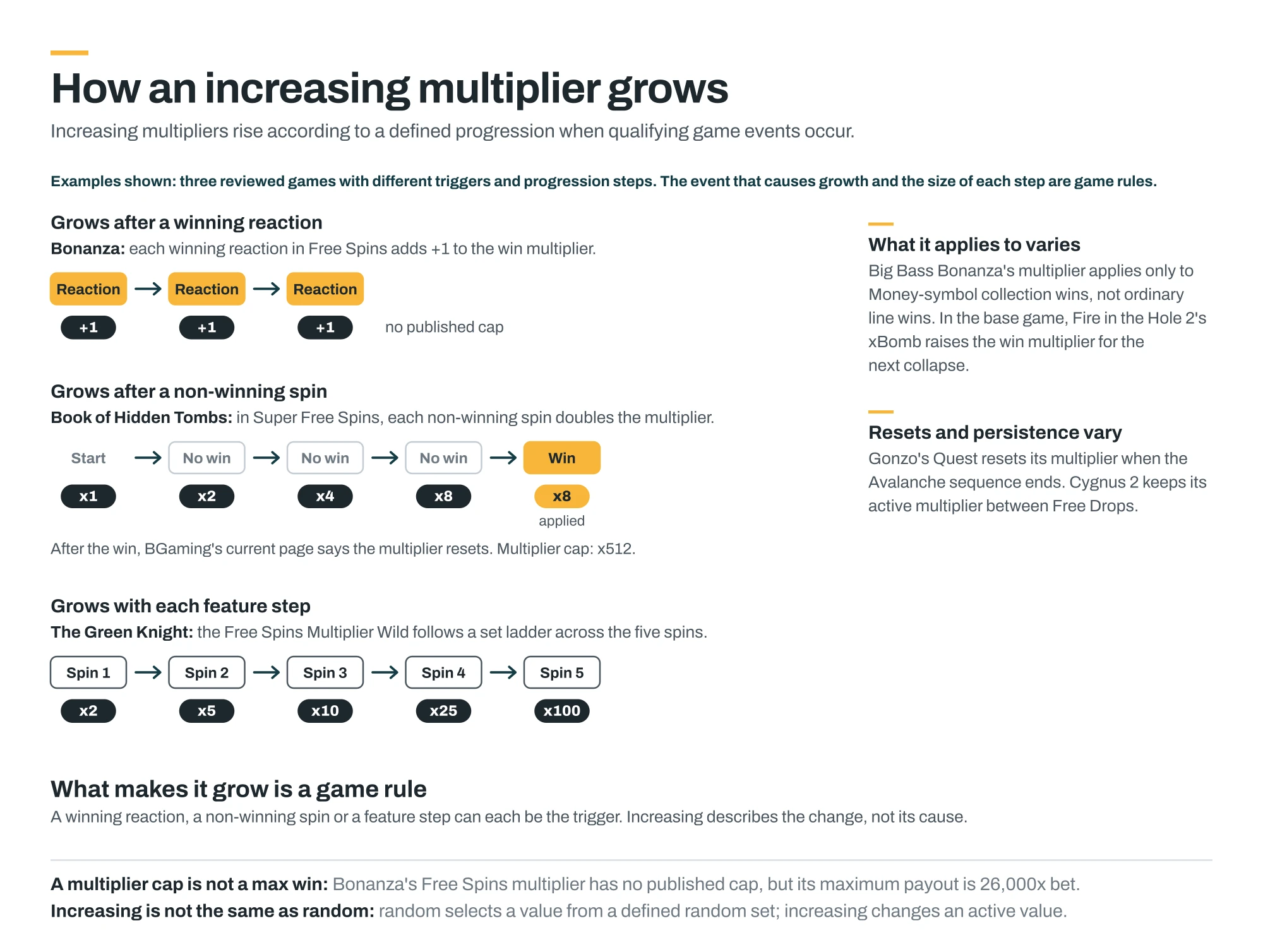
Book of Hidden Tombs turns that pattern on its head. Its Super Free Spins multiplier starts at x1 and doubles after each non-winning spin, up to x512. When a winning spin arrives, the multiplier is applied, and BGaming’s current game page says it then resets.
Together, those examples show why the trigger matters. A win or cascade can make a multiplier grow, but neither is part of the definition.
What can make a multiplier increase?
There is no universal trigger. The event that makes the multiplier grow is a game rule in its own right.
Winning cascades or reactions
Gonzo’s Quest increases its multiplier as new Avalanches continue the current sequence. Bonanza uses another reaction-based model during Free Spins: every winning reaction increases its win multiplier by +1.
Non-winning spins
Book of Hidden Tombs is the clearest counterexample. During Super Free Spins, each non-winning spin doubles the multiplier. A winning spin applies the current value instead of being the event that makes it larger.
Feature steps
The Green Knight ties progression to the position of the spin within its Free Spins sequence. Its guaranteed Multiplier Wild starts at x2 and then advances through x5, x10, x25 and x100 across the five spins.
Collection thresholds
Big Bass Bonanza uses a collection ladder. Its Money-symbol collection multiplier begins at x1, then advances to x2, x3 and x10 after the first, second and third four-Wild thresholds. The increase belongs to the Fisherman collection feature rather than to ordinary line wins.
Position or symbol events
Cygnus 2 makes position itself the trigger. When a Multiplier symbol reaches the leftmost column, its value is added to the current active multiplier and the symbol then transforms into a Wild. During Free Drops, the active multiplier persists between drops.
Razor Shark ties multiplier growth to Mystery-symbol movement during Free Games. Every one-position nudge increases the feature multiplier, which Push Gaming says applies to line wins and Razor Reveal instant awards.
Gates of Olympus provides another variation during Free Spins. Qualifying Multiplier symbol values are added into a running total that persists across the feature, so the active total can increase by different amounts rather than following a fixed +1 step or predetermined ladder.
How can an increasing multiplier progress?
The trigger tells you when the multiplier changes. The next question is how it changes.
Bonanza adds a fixed +1, Book of Hidden Tombs doubles, The Green Knight follows a predefined ladder, Cygnus 2 adds an incoming value to the active multiplier, and Big Bass Bonanza advances at collection thresholds.
So “increasing multipliers go up by x1 after every win” is too narrow. That is one way the mechanic can work, not a rule that applies to every game.
What does an increasing multiplier apply to?
A growing multiplier still needs a target. It might apply across a sequence or feature, belong to one particular award, or affect only the next event.
In Big Bass Bonanza, the progressive multiplier applies to Money-symbol collection wins from the Fisherman feature. It does not multiply ordinary line wins.
Fire in the Hole 2 is narrower again. In the base game, when an xBomb Wild explodes, its value increases the win multiplier for the next collapse. That gives the increased multiplier a short, clearly defined lifetime rather than a feature-long state.
Scope mattersA growing number does not automatically multiply every win on screen. Check whether the multiplier applies to a sequence, a feature, a collection award, a Wild-related win or one specific follow-up event.
How long can an increasing multiplier last?
The increased value might survive for only one follow-up event, remain through the current cascade sequence or persist across an entire bonus.
In Gonzo’s Quest, the documented multiplier progression is tied to successive Avalanches in the active sequence. Cygnus 2 carries its active multiplier between Free Drops. Big Bass Bonanza’s upgraded collection multiplier applies through the retriggered Free Spins batch that follows the threshold, with a later threshold advancing it to the next value.
Sugar Rush uses position-based Multiplier Spots that build from x2 up to x128 after repeated winning explosions on the same grid cells. In the base game, those marked positions last only through the current tumble sequence; during Free Spins, they persist across later spins and can keep increasing.
Persistence and progression are different ideas: a multiplier can stay active without continuing to grow.
When do increasing multipliers reset?
The reset rule decides where one run of multiplier growth ends and the game returns to its baseline.
For Gonzo’s Quest, the reviewed NetEnt material establishes how the multiplier rises through successive Avalanches but does not explicitly state a separate reset rule between paid game rounds. Book of Hidden Tombs is different: BGaming’s current game page says the Super Free Spins multiplier resets after it is applied to a winning spin. Big Bass Bonanza starts its Money-symbol collection multiplier at 1x in a new Free Spins round before the documented four-Wild thresholds increase it.
A reset can therefore come after a sequence, after a feature, after a win or under another game-specific condition. “Increasing” does not mean the multiplier simply keeps climbing until the bonus is over.
Capped vs unlimited increasing multipliers
Some increasing multipliers have a stated maximum. Others have no published multiplier cap. Either way, that is separate from the game’s overall payout ceiling.
Book of Hidden Tombs has a stated Super Free Spins multiplier maximum of x512. Big Bass Bonanza has a maximum collection multiplier of x10. By contrast, Big Time Gaming describes Bonanza‘s Free Spins multiplier as unlimited, with every winning reaction adding +1 and no published multiplier cap.
That does not mean Bonanza has an unlimited maximum win. The same first-party material separately documents a finite maximum payout of 26,000x bet.
A multiplier cap and a maximum win are different limits. An uncapped multiplier progression does not remove the game’s separate payout ceiling.
Increasing Multipliers vs Random Multipliers and Multiplier Wilds
These labels answer different questions about the same broader family of mechanics.
Increasing Multipliers describe progression: the active multiplier value rises according to a defined rule. Random Multipliers describe how a multiplier value is determined: it is selected from a defined random value set.
A Multiplier Wild is a Wild that carries or applies a multiplier. It can also be increasing, but it does not have to be. The Green Knight combines the ideas because its guaranteed Free Spins Multiplier Wild progresses through a predefined sequence of values.
Persistence is separate again. A multiplier can remain active without continuing to rise, so a Sticky Wild or another persistent state is not automatically an increasing multiplier.
Increasing multiplier examples compared
| Game | What makes it increase? | Progression and scope | Reset / limit |
|---|---|---|---|
| Gonzo’s Quest | Each new Avalanche in the active sequence. | Main game documented x1 to x5; Free Falls x3 to x15. | Resets for the next independent sequence; mode-specific caps. |
| Book of Hidden Tombs | Each non-winning Super Free Spins spin. | Starts x1 and doubles; current value applies on a winning spin. | BGaming’s current page says it then resets; maximum x512. |
| The Green Knight | Advancing through the five Free Spins. | Multiplier Wild follows x2, x5, x10, x25, x100. | Progression covers the five Free Spins. |
| Cygnus 2 | A Multiplier symbol reaches the leftmost column. | Its value is added to the active multiplier; it then becomes a Wild. | Active multiplier persists between Free Drops. |
| Big Bass Bonanza | First, second and third four-Wild collection thresholds. | Money-collection multiplier progresses x1, x2, x3, x10. | Maximum x10; applies to the feature’s collection awards. |
| Fire in the Hole 2 | In the base game, an xBomb Wild explodes. | xBomb value increases the win multiplier for the next collapse. | Applies to the next collapse only. |
| Bonanza | Each winning reaction during Free Spins. | Win multiplier increases by +1. | No published multiplier cap; game still has a finite 26,000x maximum payout. |
What the Increasing Multiplier label does not tell you
Knowing that a slot has an increasing multiplier still leaves several questions unanswered: what makes it grow, how quickly it progresses, what it multiplies, whether it persists between spins and when it resets.
The label also tells you nothing by itself about RTP, volatility, hit frequency, feature frequency, maximum win or the likelihood of winning. A larger multiplier value or an uncapped progression should not be treated as evidence that a game is more likely to pay or offers better value.
Cascading Reels, Free Spins, Wilds and Symbol Collection can all provide the setting for an increasing multiplier without defining how that multiplier progresses.
Increasing Multipliers FAQ
What are increasing multiplier slots?
They are slots where an active multiplier rises according to a defined progression as qualifying game events occur. What causes the increase, how the value grows, what it applies to and when it resets all vary by game.
How do increasing multipliers work?
The game has a current multiplier and raises it when a specified event occurs. That might be a winning cascade, a losing spin, a feature step, a collection threshold or another game-specific trigger.
Do increasing multipliers always rise after a win?
No. Gonzo’s Quest increases its multiplier through successive winning Avalanches, but Book of Hidden Tombs doubles its Super Free Spins multiplier after non-winning spins.
Can a slot multiplier increase after a losing spin?
Yes. Book of Hidden Tombs is a documented example: each non-winning Super Free Spins spin doubles its progressive multiplier, up to x512.
What is the difference between increasing and random multipliers?
Increasing describes progression in an active multiplier state. Random describes how a multiplier value is determined from a defined random value set. Those are separate properties.
Do increasing multipliers reset?
They can, but the timing is game-specific. Gonzo’s Quest resets at the end of an independent Avalanche sequence. Book of Hidden Tombs uses a different rule: BGaming’s current page says its Super Free Spins multiplier resets after being applied to a win.
Can increasing multipliers persist through Free Spins?
Yes. Bonanza’s win multiplier grows during Free Spins, and Cygnus 2 preserves its active multiplier between Free Drops. Persistence is separate from the rule that makes the multiplier increase.
What is the difference between capped and unlimited increasing multipliers?
A capped multiplier has a stated maximum value. An unlimited multiplier has no published multiplier cap under the cited rule. That does not mean the game’s overall maximum payout is unlimited.
Is an increasing multiplier the same as a Multiplier Wild?
No. Increasing describes progression. Multiplier Wild describes a Wild symbol that carries or applies a multiplier. A game can combine both behaviours, as The Green Knight does during Free Spins.
Does a larger multiplier mean a larger maximum win?
Not necessarily. Multiplier size and maximum win are separate limits. Bonanza, for example, has a Free Spins multiplier described by Big Time Gaming as unlimited while the game still has a documented finite maximum payout.
Sources reviewed
The examples on this page were checked against primary material wherever possible. Linked game names below lead to the software provider’s public game page where one was available. The evidence reviewed may also include in-game rules, developer game sheets and authenticated developer material that is not publicly accessible.
NetEnt
BGaming
Play’n GO
ELK Studios
Pragmatic Play / Reel Kingdom
Nolimit City
Big Time Gaming
How we research slot mechanics
Slotathon starts with primary evidence such as game rules, in-game help, developer documentation and game sheets. Third-party reviews are used as secondary sources to compare against that evidence and help identify areas that may need further verification.
When sources disagree, we preserve the disagreement in the research instead of quietly choosing whichever version is easiest to publish.