
243 Ways to Win Slots: How the System Works
Ways to Win removes fixed line paths, but it does not remove structure.
Matching symbols still have to connect across qualifying consecutive reels,
and the number of possible combinations can vary from one game or mode to another.
qualifying consecutive reels without requiring a predefined payline path.
243 Ways is one version of the mechanic, not the mechanic itself.
Many reviewed Ways games evaluate from left to right, but verified Both Ways
variants also exist.
What does Ways to Win mean in slots?
The easiest way to understand Ways to Win is to forget about drawn paylines for a moment.
A Ways game looks for matching symbols across qualifying consecutive reels rather than
asking whether those symbols sit on one predefined line.
That means matching symbols can sit at different heights on the grid. What matters is the
reel sequence. If the game’s rule requires adjacent reels, a gap can break the combination.
Providers use several labels for this broad payout idea. You may see
Ways to Win, Ways Pays or Win Ways.
NetEnt uses the term betways in Vikings Video Slot. The wording varies,
so the game rules matter more than the label.
Depths of Fortune makes the structure unusually clear. Its in-game rules
say three identical symbols on adjacent reels can form a win regardless of vertical alignment,
while a one-reel gap means no win.
Compare that with
Fixed Paylines,
where the qualifying symbols have to occupy positions on one of the game’s predefined paths.
How does a Ways win work?
A Ways win is built from matching symbol positions on qualifying consecutive reels.
If more than one matching symbol appears on a reel, those extra instances can create
additional combinations.
Barbarossa Beyond The Edge states this directly: identical symbols on
3, 4 or 5 consecutive reels from the left can win, and multiple matching instances on
a reel multiply the number of winning ways.
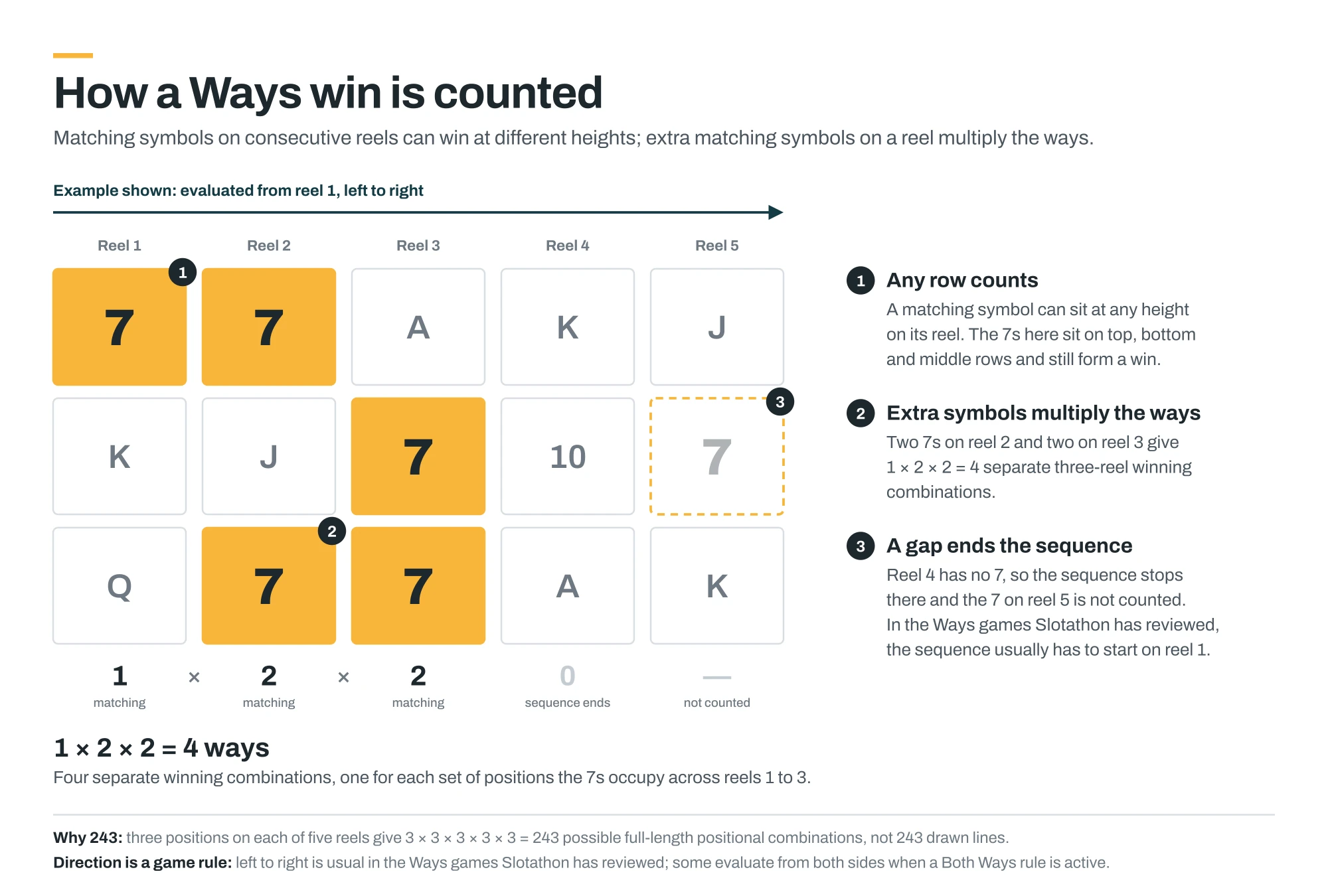
consecutive reels, while additional matching symbols on a reel can create additional
positional combinations. The qualifying sequence and win direction depend on the game’s rules.
In the illustrated example, one matching symbol on Reel 1, two on Reel 2 and two on Reel 3
create 1 × 2 × 2 = 4 separate three-reel combinations. The gap on Reel 4
stops that sequence, so the matching symbol on Reel 5 is not part of those four ways.
These are combinations of positions across reels. Nothing is being traced along a pre-drawn line.
Do Ways wins need symbols on the same row?
No.
In the Ways games Slotathon has reviewed, vertical alignment is not what decides whether
a combination qualifies. Matching symbols can sit on different rows so long as they satisfy
the game’s reel-sequence rule.
Buffalo King, for example, uses 4,096 Ways. Its in-game rules describe
wins running left to right across consecutive adjacent reels rather than along fixed paylines.
A symbol near the top of Reel 1 can therefore combine with one near the bottom of Reel 2
and another in the middle of Reel 3. They do not need to trace a neat visual line.
Why 243 Ways is not 243 paylines
The phrase 243 Ways is easy to misread as “243 paylines”.
They are not the same thing.
Barbarossa Beyond The Edge is a clean example. It uses a fixed
5×3 grid and publishes 243 Ways to Win.
With three symbol positions on each of five reels, there are 243 possible full-length
positional combinations across that fixed grid. Those combinations are the “ways”.
They are not 243 separately drawn line paths.
Barbarossa can still award qualifying symbol wins across 3, 4 or 5 consecutive reels.
The published 243 figure describes the game’s Ways structure, not a requirement that every
win must use all five reels.
Do Ways wins always start on the left?
Left-to-right evaluation is common in Slotathon’s reviewed Ways games, but it is not
a universal rule.
Nitropolis 5 provides the useful exception. When its
Both Ways modifier is active, qualifying wins are evaluated from both
the leftmost and the rightmost reel.
Payout direction is a game-level rule. The defining idea is the consecutive-reel
combination structure, not one mandatory direction.
Fixed-count Ways vs variable-count Ways
Some games publish one Ways count for a particular layout. Others can change the number
of active combinations as the grid or game mode changes.
| Game | Ways structure | What it shows |
|---|---|---|
| Barbarossa Beyond The Edge | 243 Ways on a 5×3 layout | A fixed published Ways count |
| Buffalo King | 4,096 Ways on a 6×4 layout | A larger fixed-count Ways structure |
| Fire in the Hole 2 | Up to 46,656 Ways as the active grid expands | A variable count driven by reel-area expansion |
| Vikings Video Slot | 243 betways in the base game; 78,125 in Raid Spins | Different published counts in different game modes |
Fire in the Hole 2 begins with six reels and three active rows, then can
expand to six rows. Its published maximum is 46,656 Ways. This is one example of
Ways to Win interacting with
Expanding Reels:
adding active positions can increase the number of available combinations.
Vikings Video Slot changes the count by mode instead. The base game uses
243 betways on a 5×3 area, while Raid Spins expand to a 7×5 layout with 78,125 betways.
A related mechanic is
Win-Driven Reel Expansion,
where wins themselves add reel or row space. In a Ways game, that extra space can change
the active Ways count too.
The published Ways count belongs to a particular layout or mode. Change the grid, and the
number can change with it.
What is Megaways?
Megaways is related to Ways to Win, but the terms are not interchangeable.
Extra Chilli Megaways uses a six-reel variable-height layout with an
additional horizontal reel. Its developer material publishes up to 117,649 Megaways and
says adjacent matching symbols from left to right form wins.
In that game, the active reel heights determine how many Megaways are available, so the
count can change with the layout rather than staying fixed at one number.
Megaways is a branded variable-count Ways implementation, not another name for every slot
that uses Ways to Win.
Ways to Win vs Fixed Paylines vs Cluster Pays vs Pay Anywhere
These payout systems can all produce wins without the familiar look of a traditional
horizontal line, but they do not use the same rules.
| Payout system | What creates the winning arrangement? |
|---|---|
| Ways to Win | Matching symbols form combinations across qualifying consecutive reels without a predefined line path. |
Fixed Paylines |
Matching symbols occupy positions on one of the game’s predefined line paths. |
Cluster Pays |
Matching symbols form a connected group or cluster. |
Pay Anywhere |
A qualifying number of matching symbols can pay anywhere in view without a fixed line or consecutive-reel requirement. |
Ways still keeps a reel sequence. The symbols do not need a fixed line, but they cannot
simply appear anywhere on the grid unless the game has a separate rule that says so.
What the number of Ways does not tell you
A higher published Ways count describes more possible positional combinations under that
game’s rules. It does not, by itself, tell you how favourable or how volatile the game is.
The Ways count alone does not establish:
- RTP;
- volatility;
- hit frequency;
- maximum win;
- how often a feature appears;
- how likely a player is to win.
Those are separate properties and need separate evidence. A game advertising 46,656 or
117,649 Ways should not be assumed to behave more favourably than a game with 243 Ways
simply because the number is larger.
Ways to Win FAQ
What does 243 Ways to Win mean?
On a fixed 5×3 243-Ways setup, three positions on each of five reels give
243 possible full-length positional combinations. They are combinations of positions,
not 243 separately drawn paylines.
Is 243 Ways the same as 243 paylines?
No. Ways are combinations of symbol positions across qualifying reels.
Paylines are predefined paths drawn through specific reel positions.
Do Ways wins need symbols on the same row?
No. In the Ways games Slotathon has reviewed, matching symbols can occupy different
vertical positions so long as they satisfy the game’s qualifying reel sequence.
Do Ways wins always start on the left?
No. Left-to-right is common in the reviewed examples, but Nitropolis 5 is a verified
case where a Both Ways modifier can evaluate qualifying wins from either side.
What is the difference between Ways to Win and Megaways?
Ways to Win is the broader payout mechanic. Megaways is a branded variable-count
Ways implementation in which the active layout can change the number of available ways.
What is the difference between Ways to Win and Cluster Pays?
Ways to Win evaluates matching symbols across qualifying consecutive reels.
Cluster Pays
instead requires matching symbols to form a connected group on the grid.
Sources reviewed
The examples on this page were checked against primary material wherever possible.
Linked game names below lead to the software provider’s public game page. The evidence
reviewed may also include in-game rules, developer game sheets and authenticated
developer material that is not publicly accessible.
AvatarUX
In-game rules, AvatarUX game sheet, developer game description and official game page.
Big Time Gaming
Big Time Gaming factsheet and official game page.
ELK Studios
In-game rules and paytable, ELK Studios product sheet and official game page.
NetEnt
NetEnt Game Sheet v1.1, in-game paytable material and official game page.
Nolimit City
Nolimit City game sheet, current in-game rules and official game page.
Peter & Sons
Peter & Sons game sheet and official game page.
Pragmatic Play
Current in-game rules, Pragmatic Play game overview material, GLI UK certification
and official game page.
The linked game names above point to public developer game pages where available.
Some of the underlying evidence used by Slotathon is only available in-game or through
authenticated developer and client systems. Slotathon records those sources and the
claims they support in its research database but does not republish restricted material.
How we research slot mechanics
Slotathon starts with primary evidence such as game rules, in-game help,
developer documentation and game sheets. Third-party reviews are used as
secondary sources to compare against that evidence and help identify areas
that may need further verification.
When sources disagree, we preserve the disagreement in the research instead
of quietly choosing whichever version is easiest to publish.