
What Is a Payline in Slots? Fixed Paylines Explained
Paylines are one of the oldest ways to define a slot win, but the details are not always as fixed as the name suggests.
In a fixed-payline slot, the possible line patterns are set in
advance, although the number of active lines and the permitted win direction
can vary by game.
What is a payline in slots?
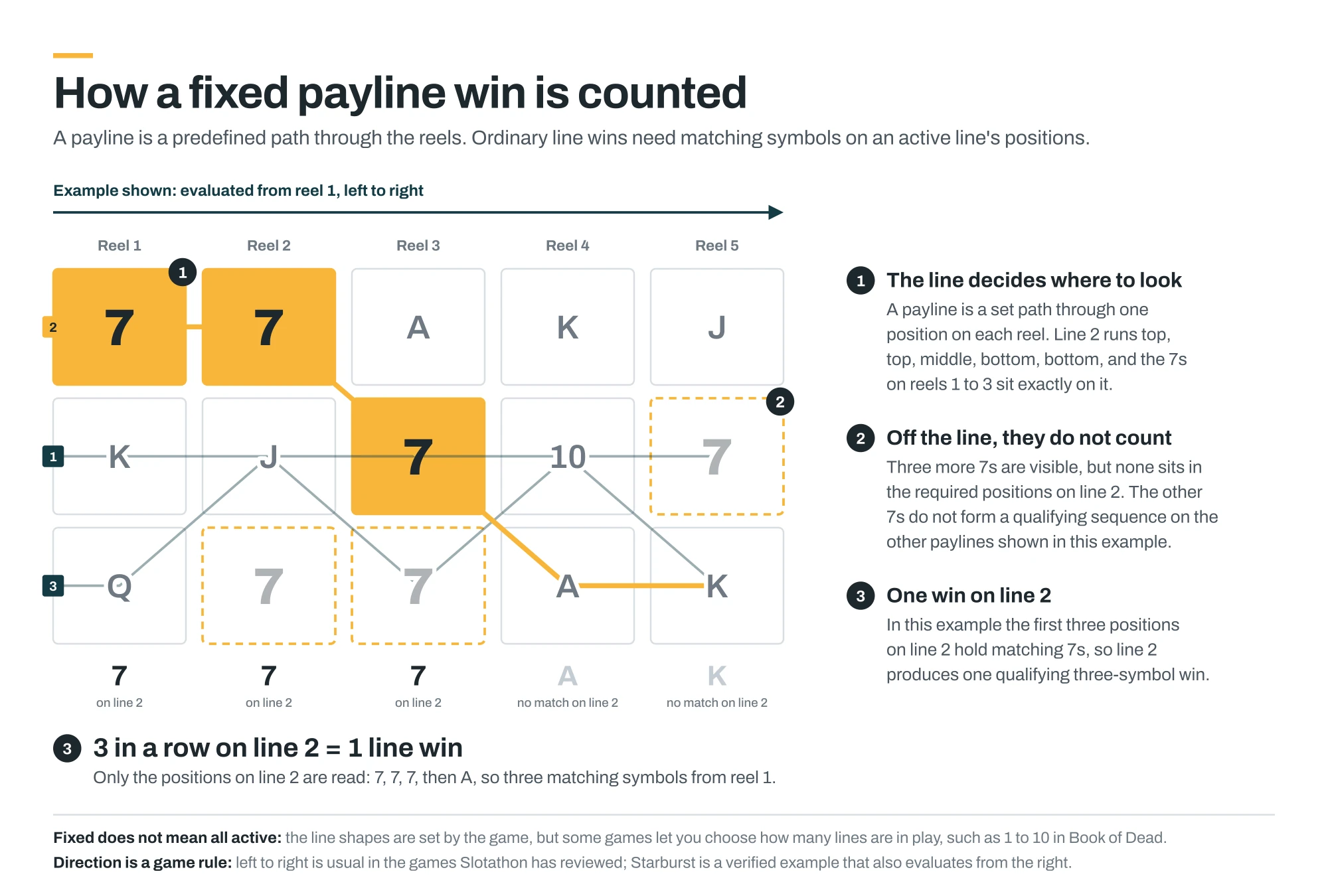
Picture a slot grid with a few paths drawn across it. One might run straight through the middle row. Another might climb diagonally. A third might zig-zag between rows.
Those paths are the paylines.
When the reels stop, the game checks the active lines against its paytable and win rules. A qualifying combination has to land on the positions that make up one of those lines.
That is different from Ways to Win, where matching symbols can form combinations across consecutive reels without following a fixed path. Cluster Pays looks for connected groups of matching symbols, while Pay Anywhere can award qualifying symbols by count anywhere in view.

They are four different ways of answering the same question: what arrangement of symbols counts as a win?
How does a payline win work?
A payline tells the game where to look. The paytable and game rules decide what must appear there.
Those rules can specify:
- how many matching symbols are needed;
- where the winning sequence must begin;
- which direction a line is evaluated;
- how many of the published paylines are active;
- how multiple wins on a line are handled.
Take Dead or Alive. Its developer documentation defines a 5×3 layout with 9 fixed bet lines. The documented medium- and low-value symbol wins run from left to right along an active line.
Battle The Beast uses 25 fixed paylines and also evaluates line wins from the leftmost reel towards the right.
Both are straightforward left-to-right examples. They do not mean every fixed-payline game works that way.
What does “fixed paylines” actually mean?
“Fixed” refers to the line geometry. The possible paths are already defined by the game.
It does not automatically mean every published line has to be active.
Book of Dead is a useful example. Its rules allow up to 10 paylines to be activated, with the lines switched on in numerical order. Legacy of Dead uses the same broad setup, allowing between 1 and 10 active paylines.
The line shapes stay the same. What changes is how many of them are in use.
That is the distinction to keep in mind when a slot lets you choose the number of lines.
Do symbols have to be on the same row?
No.
A payline is a path through specific reel positions, not simply a horizontal row. It can run straight across one row, but it can also move up and down as it crosses the reels.
What matters is whether the matching symbols land on the positions used by the active line.
This is where paylines differ sharply from Ways Pays. A Ways game can count matching symbols in different vertical positions because it is looking across consecutive reels rather than following one predefined path.
Do paylines always run from left to right?
No – although many do.
Dead or Alive and Battle The Beast are both left-to-right examples. The same direction appears in other games in Slotathon’s research, including Eye of Horus and Fishin’ Frenzy.
Starburst is the useful exception.
It has 10 fixed bet lines, but its developer documentation says qualifying line wins can be evaluated from either the leftmost reel to the right or from the rightmost reel to the left.
So a game can have fixed line patterns without having a single fixed win direction.
If you want to know which direction a particular slot pays, the game rules are the place to check.
How many paylines can a slot have?
There is no standard number.
Slotathon’s reviewed games include fixed-line examples with 5, 9, 10, 14, 20, 25, 30, 35 and 50 paylines.
Big Bass Bonanza uses 10 fixed paylines on a 5×3 grid, with regular symbol wins evaluated left to right on adjacent reels from reel 1. Its Fisherman collection feature sits on top of that fixed-line payout model rather than replacing it.
Gonzo’s Quest uses 20 fixed paylines, then applies its Avalanche cascade after a line win. It is a useful reminder that the payout system and the post-win mechanic are separate parts of the game.
| Game | Published fixed-line structure | Why the example matters |
|---|---|---|
| Dead or Alive | 9 fixed bet lines | A straightforward left-to-right example |
| Starburst | 10 fixed lines | Shows that fixed lines can pay in both directions |
| Battle The Beast | 25 fixed paylines | A larger fixed line set with left-to-right evaluation |
| Nip Tuck | 30 fixed paylines | Another variation in line count |
| Langley Street 23 | 35 fixed paylines | Shows that line counts are not limited to familiar 10, 20 or 25-line formats |
| Big Bamboo | 50 fixed paylines | Shows fixed paylines on a larger 5×6 layout |
The line count tells you something about the game’s win geometry. It does not tell you whether the game is more favourable than another.
Can a fixed-payline slot also have Scatter wins?
Yes.
A slot can use fixed paylines for ordinary symbol wins while giving a particular symbol its own separate rule.
Battleship Strike is a clean example. Its ordinary line wins use 25 defined paylines and are evaluated from left to right, while its Scatter can pay anywhere.
Rhythm Nights follows the same general pattern: fixed paylines for line wins, plus a separate anywhere-pay rule for the Scatter.
That does not make the whole game a Pay Anywhere slot.
Useful distinctionA Scatter symbol that pays anywhere is a rule for that symbol.
Pay Anywhere / Scatter Pays as the core payout system evaluates qualifying matching symbols by count anywhere in view instead of through fixed line paths.
Similar language, different behaviour.
Why “243 paylines” is usually the wrong term
A game described as having 243 Ways does not normally have 243 individually drawn payline paths.
Ways systems count qualifying symbol combinations across consecutive reels. Those combinations are the “ways”.
A true 243-payline game would need 243 separately defined line patterns.
That is why Slotathon treats Fixed Paylines and Ways Pays as different payout mechanics.
Fixed Paylines vs Ways to Win vs Cluster Pays vs Pay Anywhere
The easiest way to compare these systems is to look at what creates the winning arrangement.
| Payout system | What creates the winning arrangement? |
|---|---|
| Fixed Paylines | Matching symbols occupy positions on one of the game’s predefined line paths. |
| Ways to Win | Matching symbols form combinations across consecutive adjacent reels without a fixed line path. |
| Cluster Pays | Matching symbols form a connected group or cluster. |
| Pay Anywhere / Scatter Pays | A qualifying number of matching symbols can pay anywhere in view without a fixed line or required cluster connection. |
Wilds, Scatters, Free Spins and other features can then sit on top of whichever payout system the game uses.
What the number of paylines does not tell you
More paylines do not automatically mean more in any useful sense.
The number of paylines alone does not establish:
- RTP;
- volatility;
- hit frequency;
- maximum win;
- how often a bonus appears;
- how valuable a feature might be.
Those are separate properties of the game and need their own evidence.
A 50-line slot therefore cannot be assumed to have a higher RTP, lower volatility or a greater chance of winning than a 10-line slot simply because it has more paylines.
Fixed-payline games that show the differences
A few games are especially useful because each highlights a different part of the mechanic.
Dead or Alive keeps things simple: 9 fixed bet lines with documented left-to-right evaluation.
Starburst shows that direction can vary. Its 10 fixed lines can produce qualifying wins from either side of the reels.
Book of Dead shows that the line set can be fixed even when the number of active paylines is selectable.
Big Bamboo uses 50 fixed lines on a 5×6 layout, so fixed paylines are not tied to the familiar 5×3 grid.
Battleship Strike adds another wrinkle: ordinary symbols use fixed paylines, while its Scatter is evaluated separately anywhere on the reels.
Razor Shark keeps 20 fixed paylines underneath a much more elaborate Mystery Stack and Razor Reveal feature set. The additional features change what can happen on the reels, but the underlying payout model still uses fixed lines.
Same mechanic family, quite a few implementations.
Where fixed paylines stop and other payout systems begin
Fixed paylines describe how ordinary line wins are routed across the grid. Other rules can still sit alongside them.
A fixed-payline game can have selectable lines. It can pay from one direction or both. It can give a Scatter its own anywhere-pay rule. None of those details changes the basic point: the ordinary line wins are being checked against predefined paths.
Once the game stops relying on those paths for its core payout logic, you are looking at a different payout system such as Ways, Cluster Pays or Pay Anywhere.
Fixed Paylines FAQ
What is a payline in slots?
A payline is a predefined path across reel positions that a slot can use to evaluate a symbol win. The exact symbols, number of matches and permitted direction depend on the game’s rules.
What does a fixed payline mean?
It means the possible line pattern is defined in advance by the game. It does not necessarily mean every published line must be active on every spin.
Are all paylines active on every spin?
No. Book of Dead and Legacy of Dead are examples where the game has a fixed set of line patterns but allows between 1 and 10 active paylines.
Do paylines always pay left to right?
No. Left-to-right evaluation is common in Slotathon’s reviewed examples, but Starburst is a verified example where line wins can be evaluated in both directions.
Do matching symbols have to land on the same row?
No. They have to occupy the positions defined by a qualifying payline. A payline can move between rows as it crosses the reels.
What is the difference between paylines and Ways to Win?
Fixed paylines use predefined line paths. Ways to Win does not use those fixed paths. Matching symbols instead form combinations across consecutive adjacent reels.
Is 243 Ways the same as 243 paylines?
No. 243 Ways describes a combinations-based payout system. It does not mean the game contains 243 separately defined payline paths.
Sources reviewed
The examples on this page were checked against primary material wherever possible.
Linked game names below lead to the software provider’s public game page. The evidence
reviewed may also include in-game rules, developer game sheets and authenticated
developer material that is not publicly accessible.
NetEnt
NetEnt Game Sheet v1.1 and current official game page.
NetEnt OpenBet Game Sheet v1.2, developer factsheet, in-game rules and official game page.
Habanero
In-game rules and official Habanero game page.
In-game rules and official Habanero game page.
In-game rules, official Habanero game page and developer launch material.
Blueprint Gaming
Official Blueprint Gaming page and player instructions.
Official Blueprint Gaming page and player instructions.
Play’n GO
Rules and Settings GRS0595, product and rules material, and official game page.
Rules and Settings GRS1611 and official game page.
Sneaky Slots
Developer factsheet, launch material and official game page.
ELK Studios
ELK Studios product sheet, in-game rules and paytable, and official game page.
Push Gaming
Push Gaming game sheet, developer explainer material, gameplay captures and official game page.
The linked game names above point to public developer game pages where available.
Some of the underlying evidence used by Slotathon is only available in-game or through
authenticated developer and client systems. Slotathon records those sources and the
claims they support in its research database but does not republish restricted material.
How we research slot mechanics
Slotathon starts with primary evidence such as game rules, in-game help,
developer documentation and game sheets. Third-party reviews are used as
secondary sources to compare against that evidence and help identify areas
that may need further verification.
When sources disagree, we preserve the disagreement in the research instead
of quietly choosing whichever version is easiest to publish.