Giant & Colossal Symbols in Slots: How Multi-Position Symbols Work
Giant Symbols occupy several reel or grid positions at once. In the games Slotathon has reviewed, examples include 2×2, 3×3 and 4×4 footprints. Developers also use labels such as Giant, Colossal, Big, Mega and Huge, but those names do not guarantee the same size or behaviour.
Quick answerGiant Symbols are symbols that occupy several existing reel or grid positions at once as one oversized or linked symbol state. They can arrive already oversized, form from adjacent positions or be created by a separate growth rule, depending on the game.
What are Giant Symbols in slots?
A Giant Symbol is one oversized or linked symbol state that occupies more than one existing position at the same time. Instead of every cell necessarily holding a separate symbol, part of the grid is treated as one larger symbol under that game’s rules.
That sounds simple enough, but two 3×3 symbols can still behave very differently. The payout model, the way the symbol appears and the feature around it can all change from game to game.
What connects them is the footprint: the symbol covers several existing positions without the game having to add rows or reels.
How do Giant Symbols occupy the grid?
A Giant Symbol can get onto the grid in several ways. It can arrive already oversized, form from matching symbols in adjacent positions or be created when a game’s rules enlarge a selected symbol.
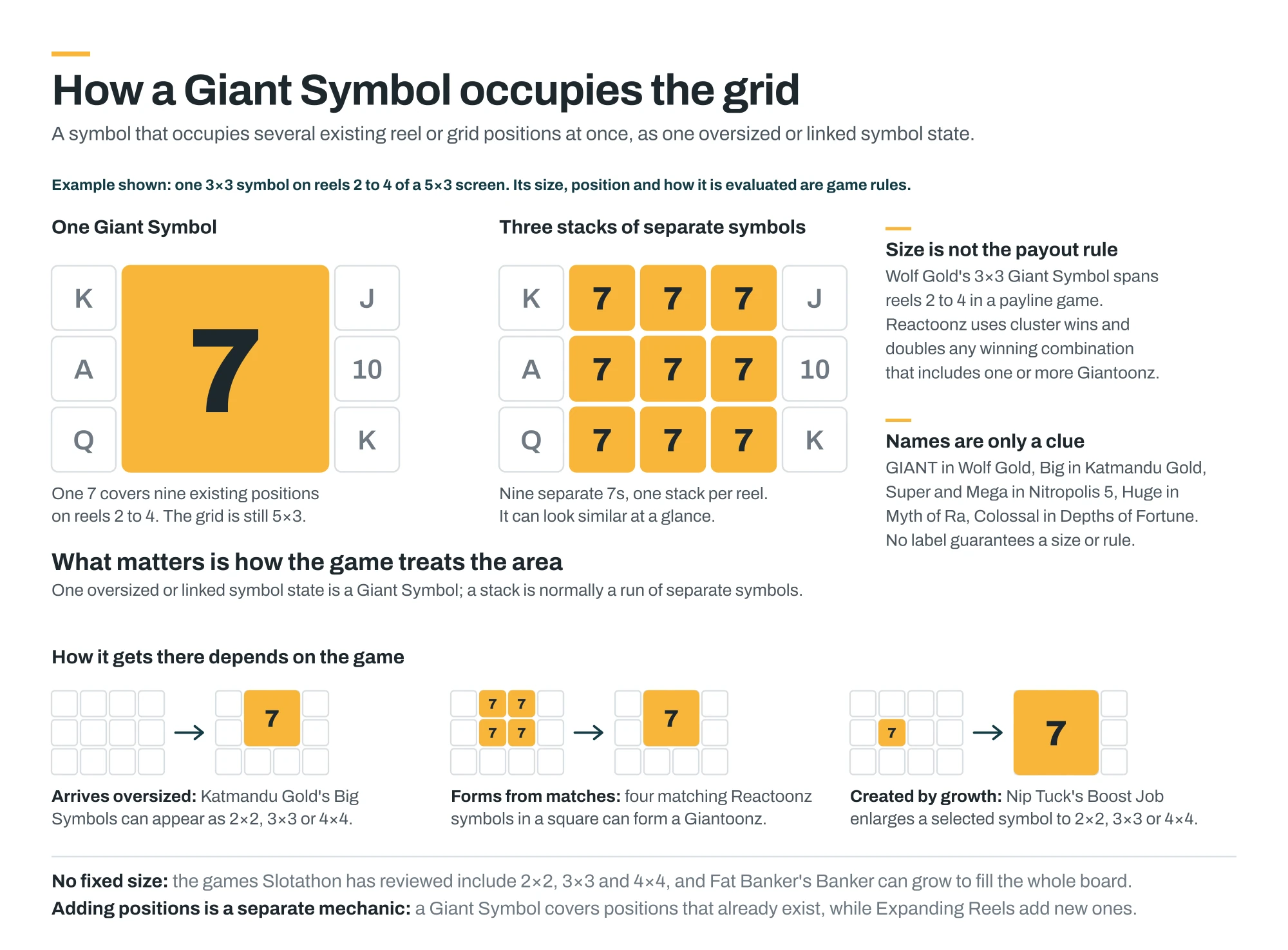
Wolf Gold is a clear example. Under its current rules, reels 2, 3 and 4 spin together during Free Spins as one Giant Symbol covering the three middle reels and all three rows. The 5×3 layout stays the same size; one symbol state simply occupies a 3×3 part of it.
Katmandu Gold takes a different approach. Paying symbols and Wilds can appear as 2×2, 3×3 or 4×4 Big Symbols, with empty positions underneath filled by the same symbol. The footprint changes, but the underlying idea does not.
Reactoonz forms Giantoonz from four matching symbols in a square, while Nip Tuck‘s Boost Job enlarges a selected Face symbol or Receipt Wild to 2×2, 3×3 or 4×4. That gives us three evidenced routes to the same broad multi-position state without making those routes interchangeable mechanics.
The useful ruleGiant describes a symbol occupying several existing positions at once. It does not tell you how that state was created, what size it must be or how the game evaluates it.
What sizes can Giant Symbols be?
The games Slotathon has reviewed include 2×2, 3×3 and 4×4 footprints, but those are examples rather than a universal size system.
Katmandu Gold can use all three of those sizes. Nitropolis 5 uses 2×2 Super symbols and 3×3 Mega symbols, which can appear on a spin or symbol drop. Different labels, same broad idea: one oversized state occupies several positions.
Fat Banker goes further. Its Banker grows as it collects during Free Spins and can ultimately fill the whole game board.
How are Giant Symbols evaluated?
Size does not tell you the payout rule. A large graphic on the grid does not automatically mean the game treats it as a fixed number of separate symbol copies.
In Wolf Gold, the 3×3 Giant Symbol spans the middle reels as part of a payline game. Reactoonz shows a different environment: four matching normal symbols adjacent in a square can form Giantoonz. Reactoonz uses cluster wins, and any winning combination that includes one or more Giantoonz is doubled.
Are Giant Symbols the same as stacked symbols?
No. A stack is normally a run of separate symbol instances placed next to each other on a reel or grid. A Giant Symbol is one oversized or linked multi-position symbol state under the game’s rules.
They can look similar at a glance, especially when a Giant Symbol fills a whole section of a reel set. What matters is whether the game treats that area as repeated individual symbols or as one larger object or linked state.
Giant Symbols vs Expanding Symbols
The cleanest distinction is state versus change. A Giant Symbol describes a multi-position state; an Expanding Symbol describes a change from a smaller footprint to a larger one.
They can still meet in the same feature. In Nip Tuck, the Boost Job selects a Face symbol or an existing Receipt Wild and enlarges it to 2×2, 3×3 or 4×4. In that game, growth is how the Giant Symbol is created; it does not make Giant and Expanding interchangeable labels.
A symbol that lands already 3×3 can be giant without having expanded at all. Conversely, an expanding mechanic is defined by the change in footprint, not by one particular final size.
Giant Symbols vs Expanding Reels
Here the distinction is between the symbol and the playing area. A Giant Symbol occupies more positions that already exist. Expanding Reels add positions to the reel or grid itself.
If a 3×3 symbol appears inside a fixed grid, the symbol has the larger footprint. If the game adds another row of positions, the grid has changed. Those can happen in the same game, but they are not the same mechanic.
Giant, Colossal, Big, Mega and Huge: do the names mean the same thing?
Not necessarily. Slot developers use their own labels, so the feature name is only a clue. The behaviour still needs to be checked.
Wolf Gold calls its linked 3×3 state a GIANT Symbol. Katmandu Gold calls its oversized symbols Big Symbols. Nitropolis 5 uses Super for 2×2 and Mega for 3×3 symbols. Myth of Ra uses Huge Symbols during Free Spins, while Depths of Fortune includes a Colossal Wild among its Loaded Reel rewards.
Those labels can all point towards multi-position behaviour, but they are not a universal taxonomy. “Mega” in one game does not guarantee the same size or rules as “Mega” in another, and the same caution applies to Giant, Colossal, Big and Huge.
Giant Wilds and other Giant Symbol interactions
A Giant Symbol does not have to be a Wild. Wild substitution is an additional property that some oversized symbols carry.
Reactoonz shows the distinction. Giantoonz forms from matching normal symbols, while Gargantoon is a 3×3 Wild added to the grid in a random position, where it substitutes for normal symbols. Both occupy multiple positions, but only one is a Giant Wild.
Fat Banker adds another layer. Its Fat Banker Symbol stays on the reels throughout Free Spins and moves to collect Wild Money Bags. Filling the collection meter makes the Banker grow.
Myth of Ra shows another variation. Huge Symbols appear during Free Spins, and a Huge coin has its own role in triggering Ra’s Gold. That trigger belongs to Myth of Ra, not to Giant Symbols as a general mechanic.
What the Giant Symbol label does not tell you
Knowing that a slot uses Giant Symbols does not tell you the footprint size, whether the symbol is Wild, how it appears, how long it remains or whether it is evaluated on paylines, ways or clusters. Those are all game-specific rules.
The label also tells you nothing by itself about RTP, volatility, hit frequency, feature frequency, maximum win or the likelihood of winning. Those characteristics need their own evidence.
Giant Symbols FAQ
What is a Giant Symbol in slots?
A Giant Symbol is one oversized or linked symbol state that occupies several existing reel or grid positions at once. How it is evaluated depends on the game.
Are Giant Symbols and Colossal Symbols the same thing?
They can describe similar multi-position behaviour, but the terminology is not standardised. “Colossal” is a developer label, so the game’s rules still need to show how the symbol actually occupies and behaves on the grid.
What sizes can Giant Symbols be?
The games Slotathon has reviewed include 2×2, 3×3 and 4×4 examples, and Fat Banker’s Banker can grow to fill the whole board. There is no universal Giant Symbol size.
Do Giant Symbols always count as multiple symbols?
No universal rule says they do. How a Giant Symbol contributes to a win is set by the individual game. In Reactoonz, for example, any winning combination that includes one or more Giantoonz is doubled.
Are Giant Symbols the same as Expanding Symbols?
No. Giant describes a symbol occupying multiple positions. Expanding describes the change from a smaller footprint to a larger one. A game can contain both when its rules separately support both behaviours.
Are Giant Symbols the same as Expanding Reels?
No. Giant Symbols cover multiple positions within the existing grid. Expanding Reels add positions to the playing area itself.
What is a Giant Wild?
A Giant Wild is a multi-position symbol that also has Wild substitution behaviour. Reactoonz’s 3×3 Gargantoon is one example.
Are Giant Symbols the same as stacked symbols?
No. Stacked symbols are repeated separate instances placed next to each other. A Giant Symbol is one oversized or linked multi-position symbol state under the game’s rules.
Sources reviewed
The examples on this page were checked against primary material wherever possible. Linked game names below lead to the software provider’s public game page where one was available. The evidence reviewed may also include in-game rules, developer game sheets and authenticated developer material that is not publicly accessible.
Pragmatic Play
ELK Studios
Play’n GO
Sneaky Slots
Push Gaming
Red Rake Gaming
AvatarUX
How we research slot mechanics
Slotathon starts with primary evidence such as game rules, in-game help, developer documentation and game sheets. Third-party reviews are used as secondary sources to compare against that evidence and help identify areas that may need further verification.
When sources disagree, we preserve the disagreement in the research instead of quietly choosing whichever version is easiest to publish.