
PopWins Slots and Win-Driven Reel Expansion Explained
Some reel-expansion mechanics wait for a bonus, collection or random event. Win-driven expansion takes a more direct route: the win itself makes the playable structure larger before the next evaluation. PopWins is one branded version of that broader idea.
PopWins is AvatarUX’s branded take on win-driven reel expansion. In HelioPOPolis, each winning symbol pops and is replaced by two, making the affected reel taller before the game evaluates the new layout. Slotathon uses Win-Driven Reel Expansion as the broader term for games where a qualifying win directly grows the playable structure, whether by adding symbol positions, full rows or additional reels.
What is win-driven reel expansion?
Win-driven reel expansion is a progression mechanic where a qualifying win directly makes the playable reel or grid structure larger before the next evaluation.
The key is the cause and effect. A win happens, the game resolves it, and the next stage of the sequence has more playable positions than before. That extra space might appear as taller reels, a new row or an additional reel.
That makes win-driven expansion a narrower branch of the broader Expanding Reels family. Plenty of games expand for other reasons, such as entering a feature, triggering a random event or collecting symbols. Here, the continuing win is what drives the growth.
What is PopWins?
PopWins is AvatarUX’s branded version of win-driven reel expansion. It is one way of building the mechanic, not another name for the whole category.
HelioPOPolis makes the idea easy to see. Its rules state that each winning symbol pops and is replaced by two symbols. The affected reel becomes taller, so the next evaluation can use a larger structure than the one that produced the previous win.
If the larger layout produces another win, the process can continue. A successful chain can therefore add playable symbol positions step by step before the sequence ends.
How does PopWins work?
In HelioPOPolis, PopWins follows a simple loop:
- a winning combination forms;
- the winning symbols pop;
- each winning symbol is replaced by two symbols;
- the affected reels become taller;
- the game evaluates the larger layout again;
- another win can continue the sequence.
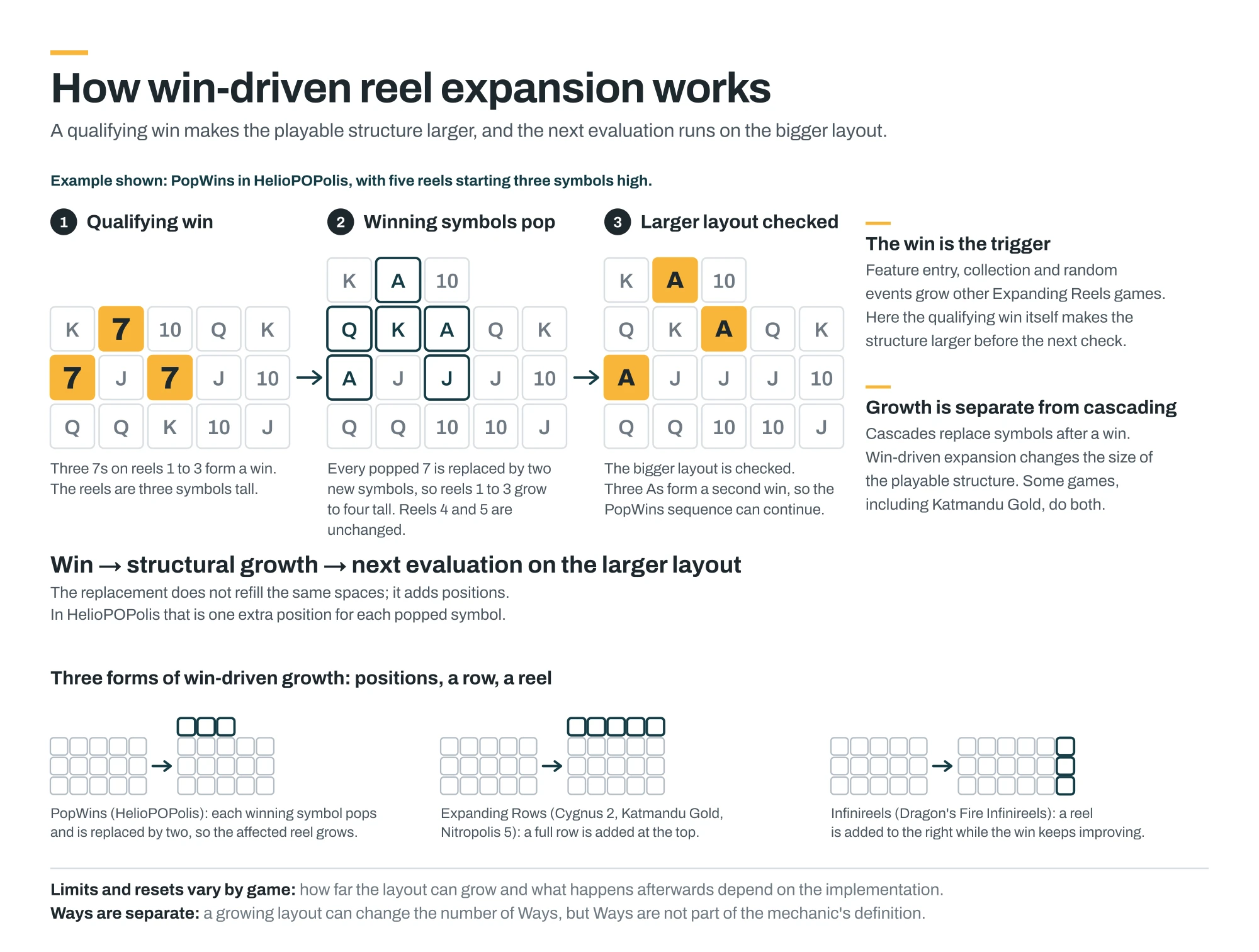
The crucial detail is that the replacement does not simply refill the same number of spaces, as it could in an ordinary fixed-size cascade. Here, it increases the number of active symbol positions.
How tall can PopWins reels become?
HelioPOPolis puts clear limits on that growth. Reels can reach 6 symbols tall in the base game and 8 symbols tall during Free Spins.
Those limits belong to HelioPOPolis rather than to PopWins as a universal rule. Other win-driven expansion games can use different structures and different growth limits.
What happens when the expanded state ends?
That depends on the game. Reset and persistence rules are not defined by the PopWins label or by win-driven expansion as a family.
In the HelioPOPolis base game, reel growth belongs to the current PopWins sequence. Once the sequence finishes, the expanded state does not carry straight into the next ordinary spin.
Free Spins work differently. Reel-height progress does not fully reset between spins. Instead, the reels reset to the height of the shortest current reel, allowing some structural progress to survive without preserving every reel at its previous height.
Dragon’s Fire Infinireels draws the line elsewhere. Added reels remain only while the active extension continues successfully; when a newly added reel fails to improve the win, those added reels are removed.
There is no family-wide reset rule to fall back on. Persistence has to be checked against the individual game’s rules.
Whole-row expansion beyond PopWins
PopWins is not the only way a win can make the play area larger. Several ELK games add a whole row at a time during a continuing win sequence.
| Game | Growth rule | Why it matters |
|---|---|---|
| Cygnus 2 | Each consecutive Avalanche win adds a row at the top, from 4 rows up to 8. | Shows whole-row growth rather than per-symbol PopWins growth. |
| Katmandu Gold | Winning symbols explode, replacements drop in and an additional row is added at the top during continuing Avalanches, up to 8 rows in the ordinary sequence. | Shows Cascading Reels and win-driven expansion working together. |
| Nitropolis 5 | Each continuing win adds a row at the top, up to 8 rows. | Reinforces whole-row growth as a broader implementation pattern rather than a PopWins-specific rule. |
The common thread is the trigger: the continuing win makes the structure larger. The difference is how. These ELK examples add whole rows, while HelioPOPolis grows individual reels through its PopWins replacement rule.
Horizontal expansion and InfiniReels
Win-driven expansion does not even have to go upwards. Dragon’s Fire Infinireels turns the same basic idea sideways.
Red Tiger’s detailed rules say a win locks the current reels, then adds a new reel to the right. If that reel increases the win, it locks too and the sequence can extend again. If it does not improve the win, the added reels are removed and the expanding state ends.
The direction has changed, but the defining relationship has not: a successful win state drives structural growth before the next continuation. Instead of making existing reels taller, the game adds reels.
First-party material conflicts over the exact starting dimensions of Dragon’s Fire Infinireels. Rather than force those sources into agreement, the useful point here is the verified expansion behaviour, not a precise starting-grid number.
Win-Driven Reel Expansion vs Cascading Reels
Cascading Reels and win-driven expansion are easy to blur together because both can continue after a win. The difference is what changes on screen.
An ordinary cascade can remove winning symbols, drop replacements into the same positions and evaluate the screen again without making the playable structure any larger.
Win-driven expansion adds playable positions before the next evaluation. Katmandu Gold shows both behaviours at once: winning symbols disappear and replacements drop in, while the Avalanche also adds another row at the top.
Put simply, the cascade explains the symbol replacement. Win-driven expansion explains why the play area itself gets bigger.
Win-Driven Reel Expansion vs Expanding Reels
Win-driven expansion sits inside the broader Expanding Reels family.
The broader Expanding Reels category covers evidenced growth or unlocking of playable structure more generally. A grid might expand when a bonus starts, when a collection condition is met or when a random feature fires.
Win-driven expansion adds one crucial condition: the win itself has to cause the next growth step. That narrower trigger is what separates the mechanic from reel expansion in general.
Does win-driven expansion always increase Ways?
No. A larger grid can increase the Ways count when the game uses a Ways to Win payout system, but Ways are not part of the mechanic’s definition.
Cygnus 2 shows the interaction clearly. It starts with 4 rows and 4,096 ways, while continuing Avalanche wins can grow the grid to 8 rows and a published ceiling of 262,144 ways.
HelioPOPolis also combines PopWins growth with an expanding Ways count. AvatarUX’s first-party help and game-sheet material state a maximum of 32,768 Win Ways. Other first-party material reviewed by Slotathon shows inconsistent displayed Ways counts, so 32,768 is best read as the developer’s stated maximum rather than a figure to reverse-engineer from every displayed grid count.
In both games, structural growth and Ways are interacting mechanics. Win-driven expansion explains why the playable structure grows; the Ways system explains how matching symbols are evaluated across it. Another win-driven expansion game can use a different payout model entirely.
PopWins and increasing multipliers
Structural growth can sit alongside Increasing Multipliers, but the multiplier remains a separate mechanic.
AvatarUX’s first-party material states that consecutive wins during HelioPOPolis Free Spins can increase the multiplier by 1. Full reel unlocks also affect the multiplier, but the first-party wording reviewed by Slotathon is not fully consistent about that additional modifier. We therefore do not standardise an exact extra value here.
That combination belongs to HelioPOPolis. A progressive multiplier should not be assumed in every PopWins or win-driven expansion game.
What Win-Driven Reel Expansion does not tell you
Watching the play area grow after a win tells you how one part of the sequence works. It says nothing by itself about how the rest of the game is tuned.
Win-driven reel expansion alone does not establish:
- RTP;
- volatility;
- hit frequency;
- maximum win;
- bonus frequency;
- winning likelihood;
- whether the game uses Ways;
- whether a multiplier will increase;
- whether the expanded state persists into later spins;
- whether the mechanic benefits the player.
Each of those properties needs its own evidence from the individual game.
PopWins and Win-Driven Reel Expansion FAQ
What is PopWins in slots?
PopWins is AvatarUX’s branded version of win-driven reel expansion. In HelioPOPolis, each winning symbol pops and is replaced by two, increasing the height of the affected reel.
Is PopWins the same as win-driven reel expansion?
PopWins is one branded form of it. Slotathon uses Win-Driven Reel Expansion as the broader term for mechanics where a qualifying win directly grows the playable reel or grid structure.
Are all win-driven expansion games PopWins?
No. Cygnus 2, Katmandu Gold and Nitropolis 5 use win-driven row growth, while Dragon’s Fire Infinireels can add reels horizontally. These are not PopWins implementations.
What happens to winning symbols in PopWins?
In HelioPOPolis, each winning symbol pops and is replaced by two symbols. That creates additional symbol positions and makes the affected reel taller.
How tall can PopWins reels become?
In HelioPOPolis, reels can reach 6 symbols tall in the base game and 8 symbols tall during Free Spins. Those limits are specific to that game.
Does PopWins reset after a win sequence?
In the HelioPOPolis base game, the reel growth belongs to the active PopWins sequence and resets afterwards. During Free Spins, some reel-height progress can carry into the next spin under the game’s partial-reset rule.
Does PopWins increase Ways to Win?
It can in a Ways-based game. AvatarUX’s first-party material states a maximum of 32,768 Win Ways for HelioPOPolis, although other first-party material reviewed by Slotathon contains inconsistent displayed Ways counts. Ways remain a separate payout system and are not part of the definition of win-driven reel expansion.
Is PopWins the same as Cascading Reels?
No. Cascades can replace symbols while keeping the same number of playable positions. PopWins-style expansion increases reel height, so the playable structure itself grows.
Can win-driven reel expansion add whole rows?
Yes. Cygnus 2, Katmandu Gold and Nitropolis 5 provide reviewed examples where continuing wins add rows to the grid.
Can win-driven reel expansion add reels horizontally?
Yes. Dragon’s Fire Infinireels adds a reel to the right after a qualifying win state and can continue adding reels while the extension keeps improving the win.
Does PopWins always have an increasing multiplier?
No. HelioPOPolis combines PopWins with multiplier progression during Free Spins, but that is a game-specific interaction rather than part of the PopWins definition. The first-party material reviewed by Slotathon is not fully consistent on the additional modifier tied to a full reel unlock, so no exact extra value is standardised here.
Sources reviewed
The examples on this page were checked against primary material wherever possible. Linked game names below lead to the software provider’s public game page where one was available. The evidence reviewed may also include in-game rules, developer game sheets and authenticated developer material that is not publicly accessible.
AvatarUX
ELK Studios
Red Tiger
How we research slot mechanics
Slotathon starts with primary evidence such as game rules, in-game help, developer documentation and game sheets. Third-party reviews are used as secondary sources to compare against that evidence and help identify areas that may need further verification.
When sources disagree, we preserve the disagreement in the research instead of quietly choosing whichever version is easiest to publish.