
Gonzo’s Quest Slot: RTP, Avalanches and Free Falls
Gonzo’s Quest is a 5×3 NetEnt slot with 20 fixed paylines. Its Avalanche mechanic removes winning symbols, drops replacements into the gaps and checks the screen again without another paid stake. Keep the sequence going and the main-game multiplier can rise as high as x5. Free Falls use the same basic loop with a higher x3-x15 multiplier range.
RTP: 95.97%
Current hit frequency: 41.00%
Current max payout: 2,200×

| Provider | NetEnt |
|---|---|
| Release | 15 March 2010 |
| Layout | 5×3 |
| Payout model | 20 fixed paylines |
| Avalanche mechanic | Winning symbols are removed, replacements fall into the gaps and the screen is evaluated again |
| Main-game multiplier | Increases with successive Avalanches, up to x5 |
| Free Falls | 3+ Free Fall symbols on a qualifying payline trigger the feature |
| Free Fall multiplier | x3-x15 |
| RTP | 95.97% |
| Current hit frequency | 41.00% |
| GB online-slot stake cap | £5 per game cycle for ages 25+; £2 for ages 18-24 |
| Current max payout | 2,200× bet |
| Core mechanics |
Fixed Paylines, Cascading Reels, Increasing Multipliers and Free Spins |
How Gonzo’s Quest works
Gonzo’s Quest starts with a familiar 5×3 layout and 20 fixed paylines. A win still has to follow one of those defined routes across the reels.
The twist comes after a line wins. NetEnt calls the process an Avalanche: the win is added, the winning symbols disappear, and new symbols fall into the empty positions. The refreshed screen is then checked again without another paid stake.
If the refill creates another payline win, another Avalanche follows. This is the Cascading Reels part of the game. The paylines decide what counts as a win; the Avalanche decides what happens next.
There is no preset stop after two or three cascades. NetEnt’s Game Sheet says there is no fixed limit to the number of Avalanches in one game round, so the sequence can continue for as long as each refill produces another qualifying win.
An Avalanche is not a new paid spin. The symbols change, but the sequence remains part of the current game round until an Avalanche produces no new win.
How the Avalanche multiplier works
Gonzo’s Quest adds an increasing multiplier to the Avalanche sequence. In the main game, the win multiplier rises as successive Avalanches occur.
NetEnt’s current game material states that the multiplier increases by one with each new Avalanche, up to x5. The 2016 Game Sheet describes the main-game range as x1-x5.
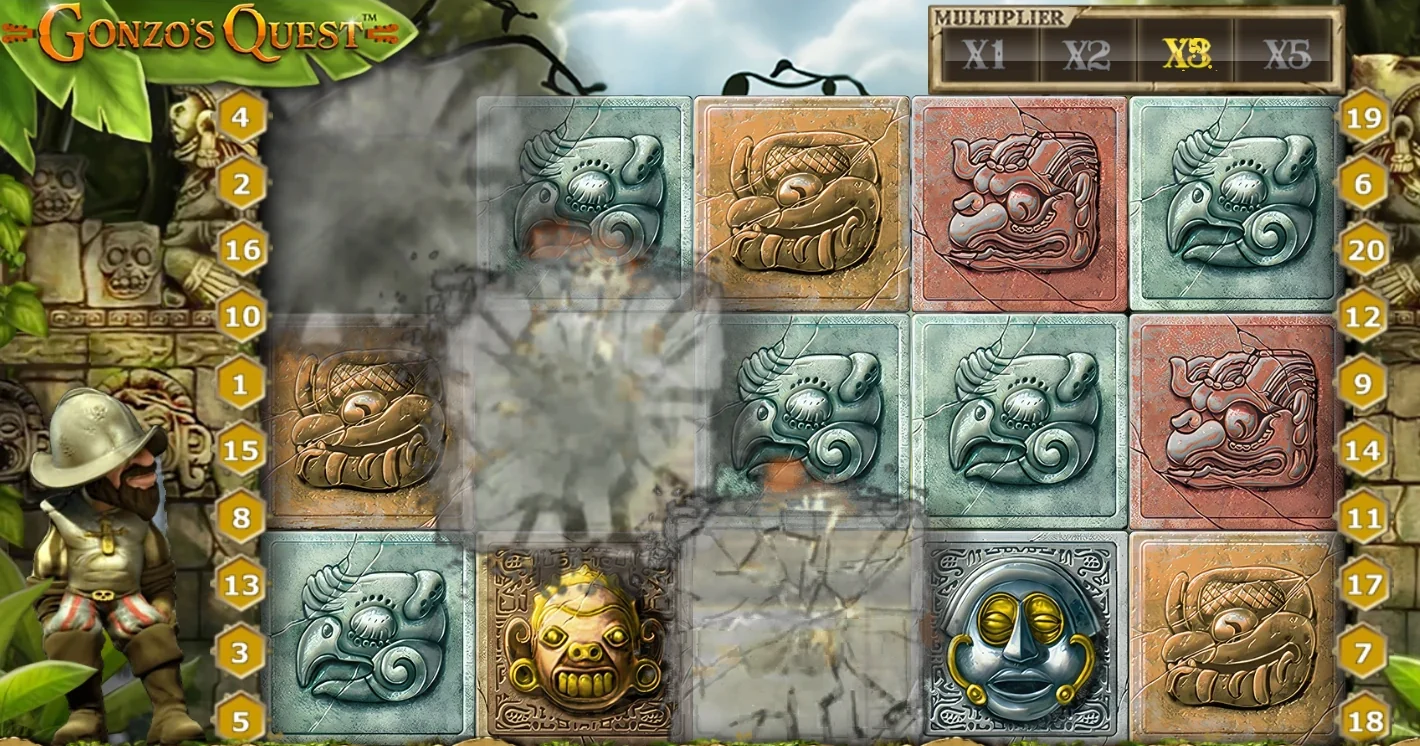
In other words, the main-game multiplier starts at x1 and can climb through successive Avalanches to x5. NetEnt’s reviewed material does not describe it as a multiplier that carries from one separate paid game round into the next.
The rising multiplier changes the value applied to wins within the sequence. It does not tell you whether the next refill is more likely to win. Cascade behaviour, multiplier progression and the game’s underlying probabilities are separate parts of the rules.
How Free Falls work in Gonzo’s Quest
Gonzo’s Quest calls its free-spin feature Free Falls. The Avalanche mechanic stays in place, but the multiplier starts and progresses at a higher level.
According to NetEnt’s Game Sheet, three or more Free Fall symbols appearing in succession on a payline from the leftmost reel award 10 Free Falls. If that triggering condition occurs on two paylines, the same document awards 20 Free Falls.
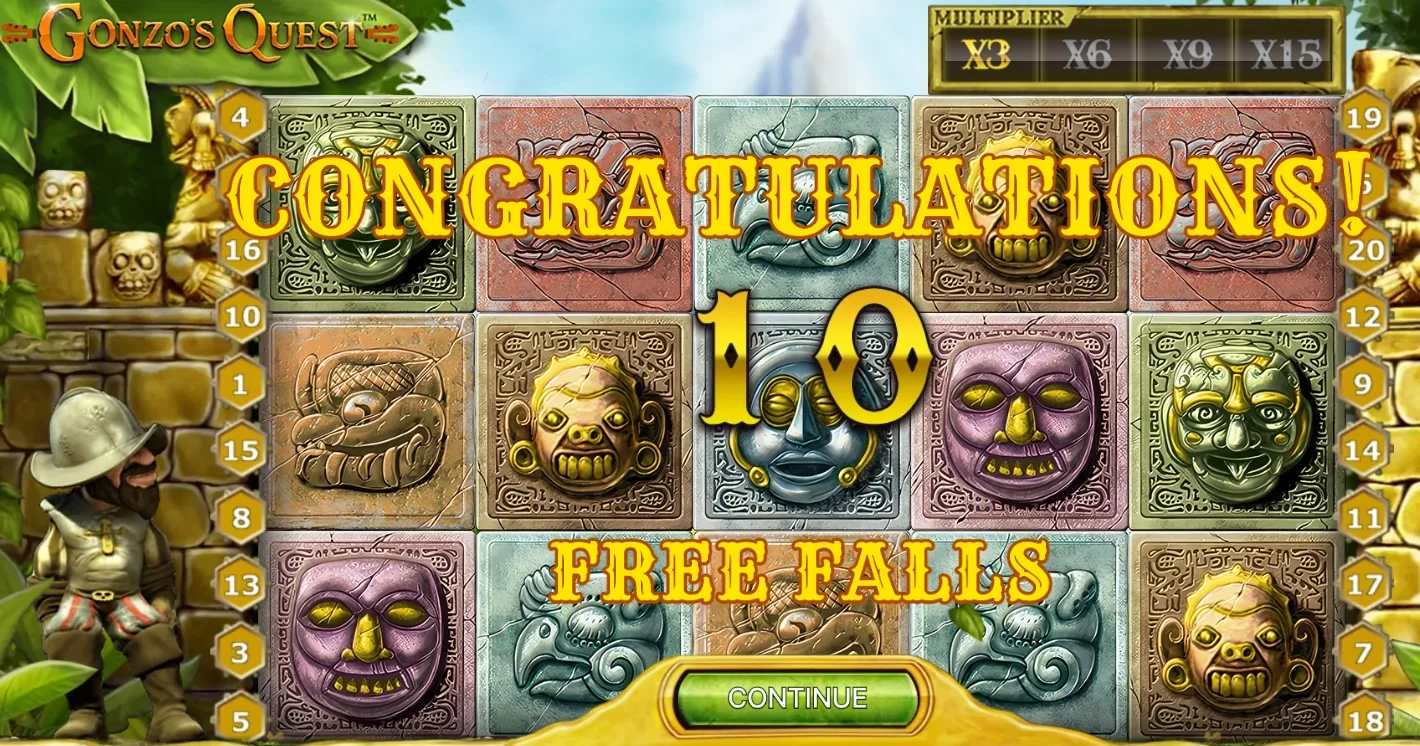
The Wild can substitute for a Free Fall symbol when completing a triggering line. That matters because the trigger is still evaluated through the game’s payline structure rather than through a separate scatter-anywhere rule.
During Free Falls, the documented Avalanche multiplier range is x3-x15. It increases as further Avalanches occur within the feature, with x15 as the documented cap.
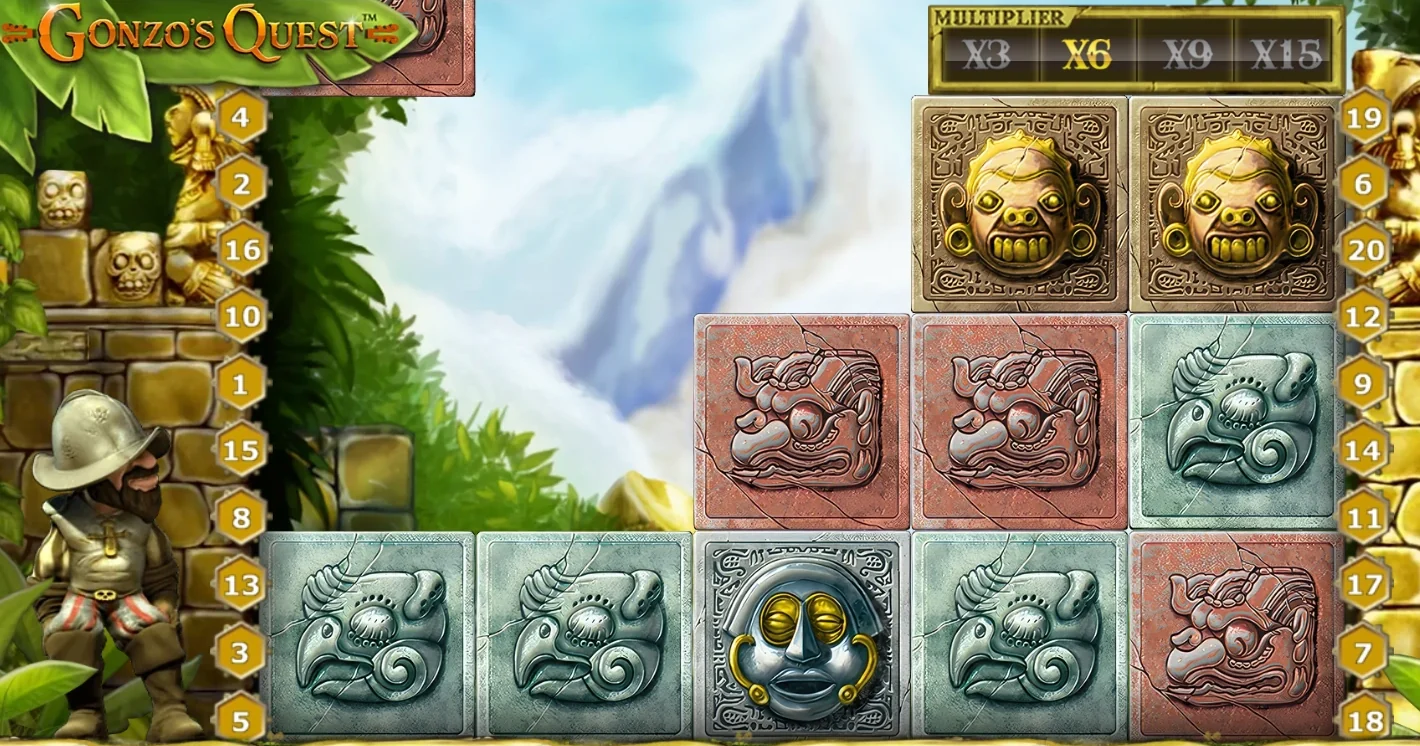
Three or more Free Fall symbols during the feature can award additional Free Falls. The Game Sheet confirms that retrigger, but it does not state a separate number of extra Free Falls, so Slotathon does not add one.
The slightly unusual part comes when the feature ends. NetEnt’s Game Sheet says play returns to the main game and the game round continues where it left off, with the Free Fall winnings included in the round total.
Gonzo’s Quest RTP, hit frequency, GB stake limits and maximum payout
RTP is the simple part: NetEnt’s current Gonzo’s Quest page and the 2016 Game Sheet both give 95.97%.
Hit frequency is slightly less tidy. The current page lists 41.00%, while the older Game Sheet gives 41.10% for the overall/main-game any-win hit frequency and 54.4% during Free Falls.
Because both figures come from NetEnt material at different points in time, Slotathon uses the current page’s 41.00% in the headline facts and keeps the older 41.10% figure here for context.
For Great Britain, the relevant stake ceiling is set by regulation. Gambling Commission guidance states that the maximum stake per game cycle for online slots is £5 for customers aged 25 and over and £2 for customers aged 18 to 24. The £5 limit took effect on 9 April 2025 and the £2 limit on 21 May 2025.
Those are statutory ceilings, not a promise that every Gonzo’s Quest client will offer those exact stakes. A game or operator can set a lower maximum.
NetEnt’s current page lists a maximum payout of 2,200× bet.
The 2016 Game Sheet presents its maximum differently. It gives a default maximum win of €4,688 / 9,375 coins on a single bet line and explicitly notes that the win for a full game round may be higher because several falls can occur.
RTP, hit frequency and maximum payout answer different questions. None of them tells you how often a long Avalanche chain will occur, how often Free Falls will trigger or how likely a particular session is to reach the maximum.
When was Gonzo’s Quest released?
NetEnt’s current game page gives 15 March 2010 as the release date, and that is the date Slotathon uses for the game.
Taken together, the current page and the 2016 Game Sheet show the same core game at different points in time. Where the presentation has changed, such as hit-frequency rounding or the way the maximum payout is expressed, Slotathon keeps the distinction rather than flattening the two documents into one version.
What about volatility and Feature Buy?
NetEnt’s reviewed first-party material does not give a volatility label we can confidently attach to the version covered here. So this page does not assign Gonzo’s Quest a Medium, Med-High or other volatility category.
The same source set does not establish a paid Bonus Buy or Feature Buy for this version either.
Both points are deliberately limited to the material reviewed here. They are not claims about every historical build, jurisdiction or operator configuration.
Gonzo’s Quest FAQ
How does Gonzo’s Quest work?
Gonzo’s Quest uses a 5×3 layout with 20 fixed paylines. After a payline win, the winning symbols are removed, replacement symbols fall into the gaps and the screen is evaluated again without another paid stake. Successive Avalanches can also increase the win multiplier.
What is an Avalanche in Gonzo’s Quest?
An Avalanche is NetEnt’s name for the post-win cascade. Winning symbols are removed, new symbols fall into the empty positions and the refreshed screen is checked for another payline win.
How many Avalanches can happen in one round?
NetEnt’s Game Sheet states that there is no fixed limit to the number of Avalanches in a game round. The sequence continues while each refreshed screen produces another qualifying win.
How does the Avalanche multiplier work?
The main-game win multiplier rises as successive Avalanches occur in the same sequence. NetEnt documents a main-game range of x1-x5, with the current page stating that the multiplier increases by one per Avalanche up to x5.
How do you trigger Free Falls in Gonzo’s Quest?
NetEnt’s Game Sheet states that three or more Free Fall symbols appearing in succession on a payline from the leftmost reel award 10 Free Falls. The Wild can substitute for Free Fall symbols when completing a triggering line.
How many Free Falls do you get?
One qualifying trigger line awards 10 Free Falls. The Game Sheet states that if the triggering condition occurs on two paylines, 20 Free Falls are awarded.
Can Free Falls retrigger?
Yes. The reviewed NetEnt Game Sheet states that three or more Free Fall symbols during Free Falls award additional Free Falls. The source reviewed by Slotathon does not state a separate retrigger quantity that should be assumed beyond that.
What multiplier is used during Free Falls?
NetEnt documents an Avalanche multiplier range of x3-x15 during Free Falls, with x15 as the maximum.
Can the Wild substitute for a Free Fall symbol?
Yes. NetEnt’s Game Sheet states that the Wild can substitute for Free Fall symbols to complete a triggering payline.
What is the RTP of Gonzo’s Quest?
NetEnt’s current game page and its 2016 Game Sheet both state an RTP of 95.97% for the material reviewed by Slotathon.
What is the hit frequency of Gonzo’s Quest?
NetEnt’s current page lists 41.00%. The older Game Sheet gives 41.10% for the overall/main-game any-win hit frequency and 54.4% during Free Falls.
What is the maximum stake for Gonzo’s Quest in Great Britain?
For online slots in Great Britain, the statutory maximum stake per game cycle is £5 for customers aged 25 and over and £2 for ages 18 to 24. Those are legal ceilings, so a Gonzo’s Quest client or operator can offer a lower maximum.
What is the maximum payout in Gonzo’s Quest?
NetEnt’s current game page lists a maximum payout of 2,200× bet. An older NetEnt Game Sheet presents its maximum differently, using a single-line currency/coin figure and noting that a complete game-round win may be higher because several falls can occur.
Does Gonzo’s Quest have a Feature Buy?
The first-party NetEnt material reviewed for this page does not establish a paid Bonus Buy or Feature Buy for the version covered here.
When was Gonzo’s Quest released?
NetEnt’s current game page lists 15 March 2010 as the release date.
Sources reviewed
The public source list uses first-party NetEnt material for the game mechanics and official Gambling Commission guidance for the Great Britain stake limits.
NetEnt
Gambling Commission
How we researched Gonzo’s Quest
Slotathon starts with developer and in-game evidence, using the strongest available first-party material for published claims.
For Gonzo’s Quest, the core mechanics come from NetEnt’s Game Sheet v1.0 and current game page. The Great Britain stake limits come from official Gambling Commission guidance. Where the two NetEnt sources present a figure differently, such as hit-frequency rounding or maximum-payout format, the difference is preserved instead of silently normalised.
Read more about the process on How We Research.
Safer gambling support
Slotathon explains how slot mechanics and published game settings work. It does not predict outcomes or recommend gambling based on RTP, hit frequency, multipliers or maximum payouts.
If gambling is becoming difficult to manage, see our Safer Gambling Support page for UK support options.