Reactoonz Slot: RTP, Quantum Leap and Gargantoon
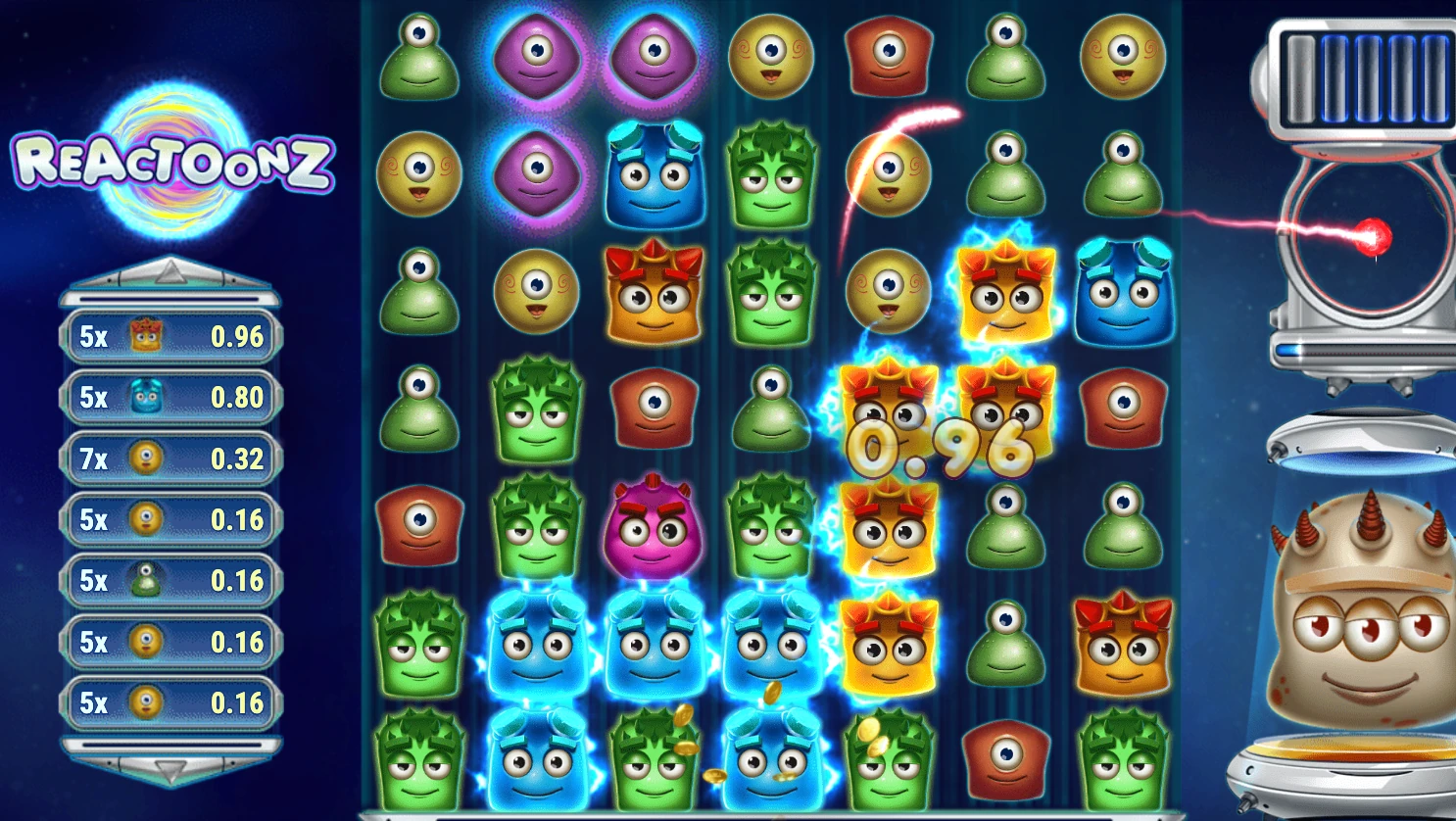
Reactoonz is a 7×7 Play’n GO grid slot where five or more matching symbols connected horizontally or vertically form a cluster win. Winning symbols disappear and new symbols cascade into the gaps. Those wins also charge five Quantum Leap meters: the first four can queue random Quantum Features, while the fifth queues Gargantoon.
Top documented RTP: 96.51%
Volatility: Very High 10/10
Maximum exposure: 4,570.3×
| Provider | Play’n GO |
|---|---|
| Release | 24 October 2017 |
| Layout | 7×7 grid |
| Payout model | Cluster Pays – 5+ matching symbols connected horizontally and/or vertically |
| Cascades | Winning symbols are removed and new symbols fall into the gaps |
| Quantum Leap | Five sequential charge meters; the first four can queue random Quantum Features and the fifth queues Gargantoon |
| Play’n GO RTP versions | 96.51%, 94.51%, 91.49%, 87.50% and 84.51% |
| Volatility | Very High 10/10 |
| Stake range in primary math | 0.20-100 |
| Maximum exposure | 4,570.3× total bet |
| Core mechanics | Cluster Pays, Cascading Reels and Giant Symbols |
How Reactoonz works
Reactoonz starts with a 7×7 grid, and a win forms when at least five matching symbols touch horizontally or vertically. There are no payline routes to follow. The winning shape can bend around the grid as long as each symbol is connected by a side.
That is the Cluster Pays part. What happens next is a separate mechanic. Winning symbols are removed, new symbols fall into the empty spaces, and the grid is checked again. If the refill creates another cluster, the sequence continues without a new paid spin.
These cascades continue until no new winning combination remains. Reactoonz then adds another layer: the wins created during that game round also charge the Quantum Leap system.
How the Quantum Leap meter works
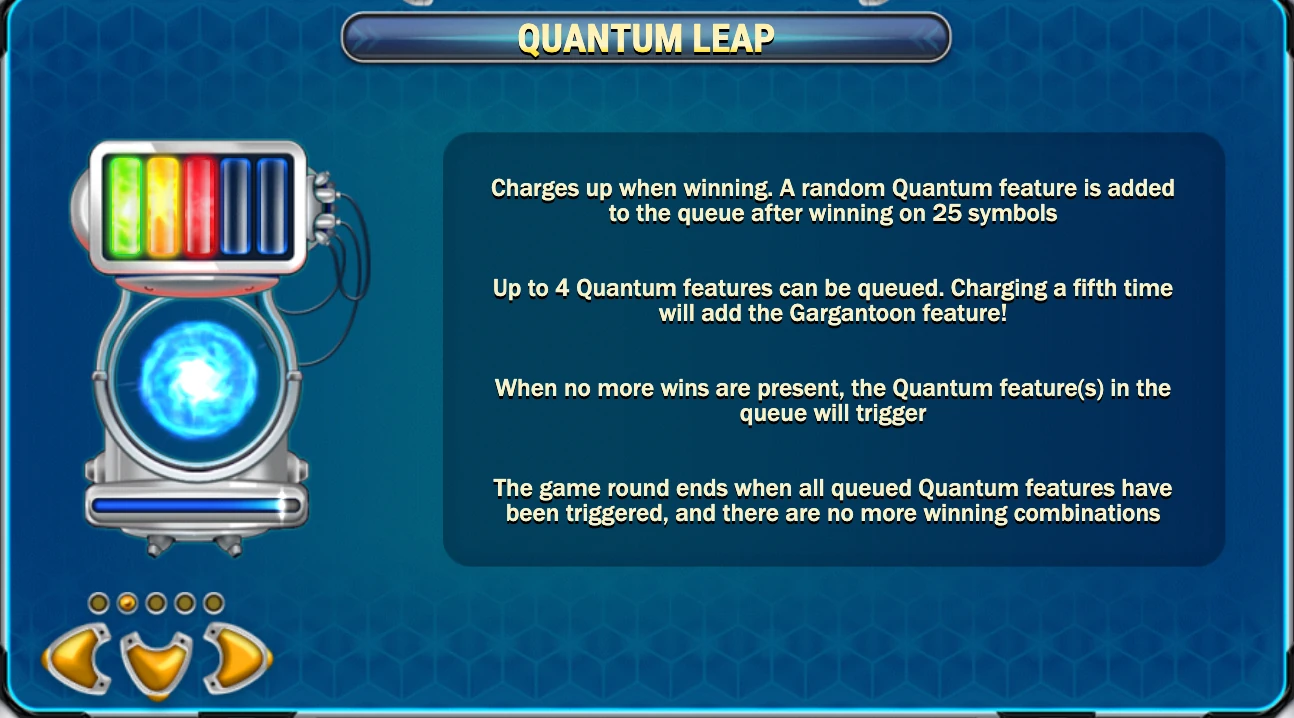
Reactoonz has five Quantum Leap charge meters that fill one after another. All wins during the current game round contribute to that progression.
The supplied in-game rules state that winning on 25 symbols completes a charge. Complete one of the first four charges and Reactoonz adds a randomly selected Quantum Feature to the queue.
The feature does not necessarily fire the instant it is queued. Ordinary wins and cascades finish first. When there are no more wins on the grid, the queued Quantum Feature or Features are triggered.
Up to four ordinary Quantum Features can be waiting in the queue. Complete the fifth charge and the game adds Gargantoon instead.
The important bit is what counts as the end of the round. Reactoonz does not reset the Quantum Leap meters simply because the first cascade sequence has stopped. The game round ends only after the queued features have resolved and there are no more winning combinations. The meters reset then.
So the meter belongs to the same developing game round rather than sitting in a separate bonus screen.
What are the four Quantum Features in Reactoonz?
The first four Quantum Leap charges choose from four grid-changing effects: Implosion, Alteration, Demolition and Incision. Each changes the grid in a different way before the result is checked again for wins.
| Feature | What it does |
|---|---|
| Implosion | Transforms 3-6 symbols into Wilds and destroys symbols adjacent to those transformed positions. |
| Alteration | Selects a symbol type and changes all matching displayed symbols into another symbol. The rules give priority to a random one-eyed symbol type when one is available. |
| Demolition | Destroys all one-eyed symbols and all matching symbols currently on the grid. |
| Incision | Places a Wild in the centre and changes two intersecting diagonal lines to the same random symbol. |
The in-game rules also state that existing Wild symbols are not affected by Quantum Features.
The names make the system sound more complicated than it is. Each feature changes or clears part of the grid, then the new layout is checked again. Another win can start more cascades and keep the same game round moving.
How Gargantoon works
Gargantoon is what the fifth Quantum Leap charge adds to the queue. It enters the grid in a random position as a 3×3 Wild and substitutes for normal symbols.
Its behaviour then unfolds in stages. When no more cascades are possible with the 3×3 version, Gargantoon divides into two 2×2 Wilds. New symbols fall in before the next stage is evaluated.
When that phase has also run out of cascades, Gargantoon divides again into nine individual 1×1 Wilds. The grid refills again before play continues.
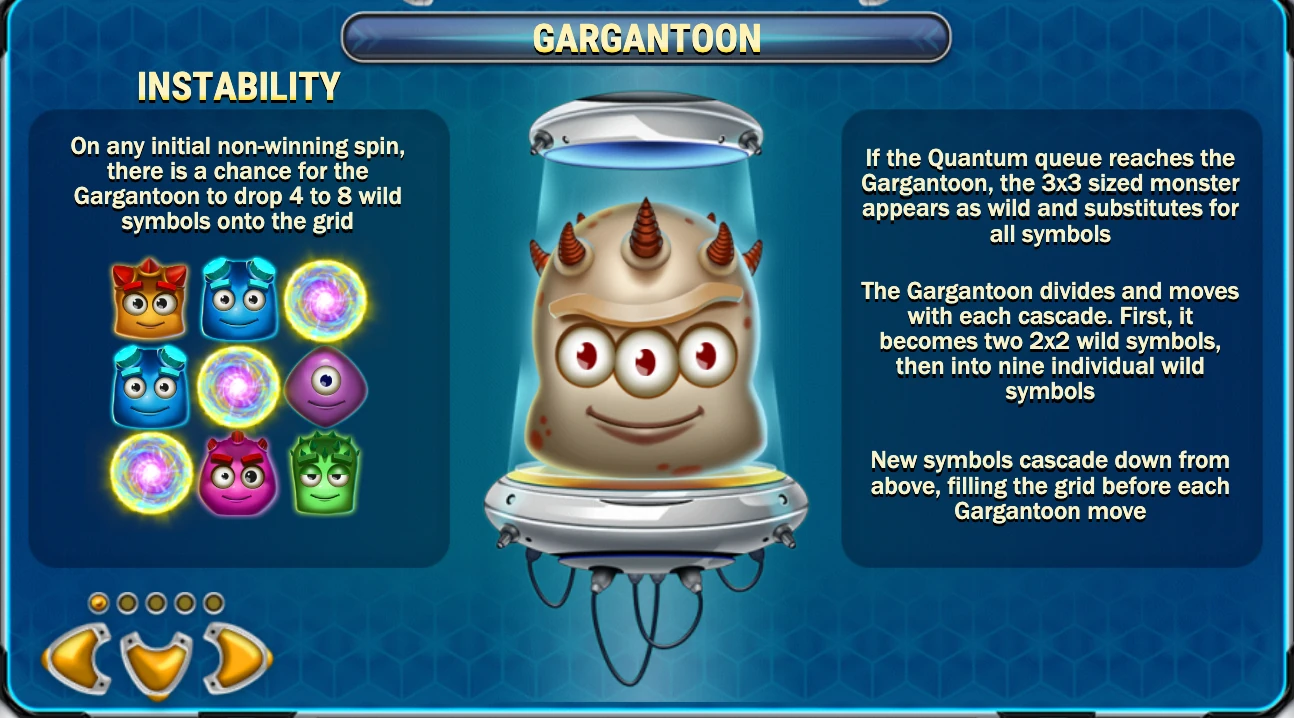
This makes Gargantoon a useful example of why broad mechanic labels need care. It starts as a Giant Wild, but its defining behaviour is not simply that it occupies a large area. It changes footprint in stages, splitting into smaller Wild units as the sequence develops.
Giantoonz, Fluctuation and Instability
Quantum Leap and Gargantoon are the headline sequence, but Reactoonz also has three behaviours that can change what happens on an ordinary spin.
Giantoonz
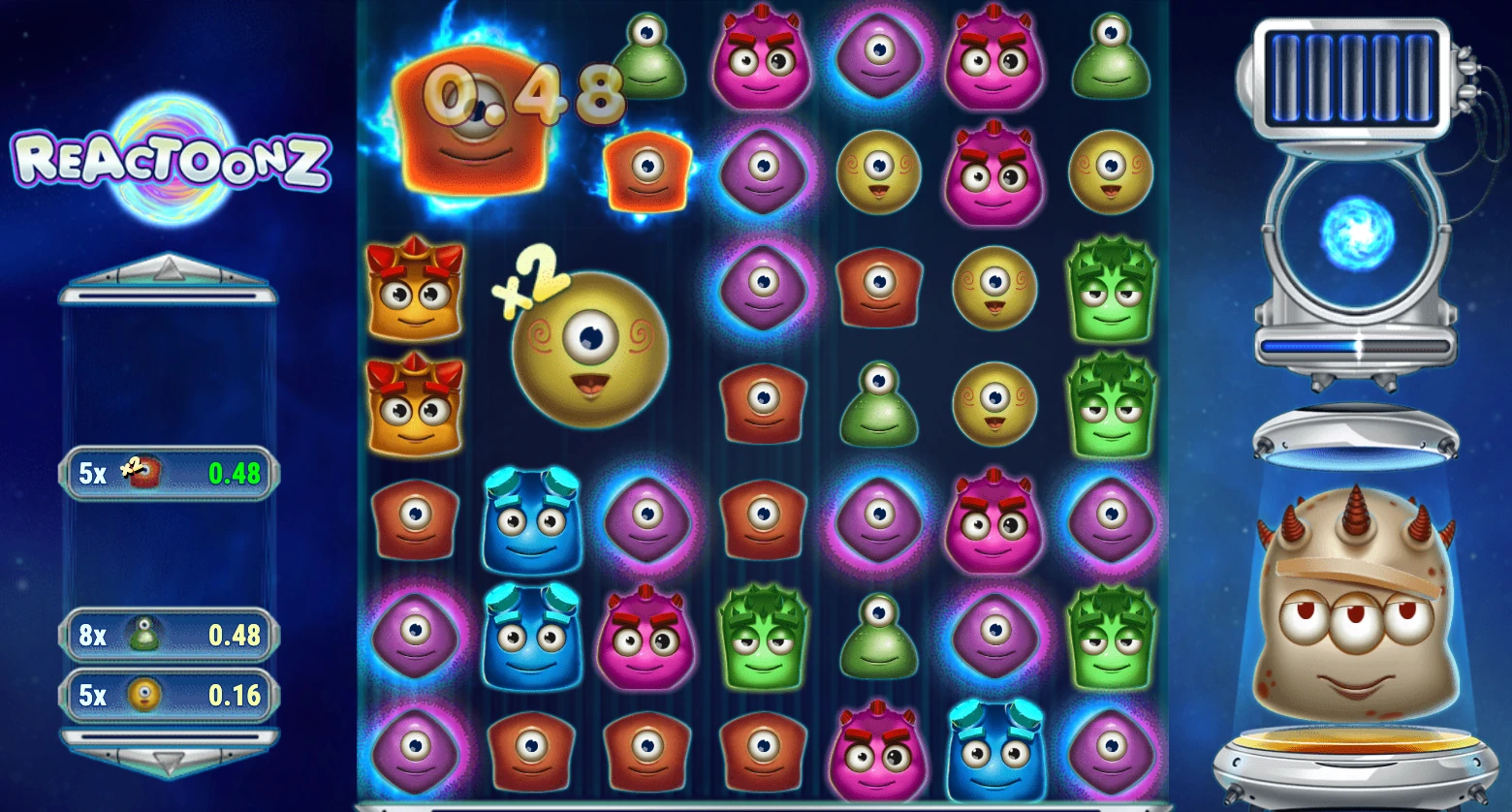
Four matching normal symbols positioned together in a 2×2 square automatically form one Giantoonz symbol. If a winning combination includes one or more Giantoonz, the rules state that the win is doubled.
Giantoonz and Gargantoon sound related because both occupy several grid positions. They are not the same feature. Giantoonz is formed from four matching normal symbols; Gargantoon is the staged Wild introduced by the fifth Quantum Leap charge.
Fluctuation
On each spin, one random one-eyed symbol type is marked as the fluctuating symbol. If those marked symbols take part in a winning combination, each winning marked symbol leaves two Wilds behind.
Those Wilds become part of the developing grid, so Fluctuation can feed directly into the same cascade-and-charge loop rather than acting as a separate bonus round.
Instability
If the initial grid does not produce a win, there is a chance for Gargantoon to drop 4-8 Wild symbols onto the grid. The primary rules document the behaviour but do not give us a reason to infer how often a player should expect it.
Reactoonz RTP and versions
Play’n GO’s primary Reactoonz rules list five RTP configurations: 96.51%, 94.51%, 91.49%, 87.50% and 84.51%.
That means 96.51% is the highest documented setting in the material Slotathon reviewed, not an RTP that should be assumed for every Reactoonz client.
The same rules mark the 91.49%, 87.50% and 84.51% configurations as not applicable to operators licensed by the Malta Gaming Authority. That is an MGA-specific restriction in the source. It is not evidence that those configurations are unavailable in Great Britain.
Reactoonz volatility, stakes and maximum exposure
The Play’n GO math module classifies Reactoonz as Very High 10/10 volatility and lists a stake range of 0.20 to 100.
The same first-party material gives a maximum exposure of 4,570.3× total bet.
RTP, volatility and maximum exposure describe different parts of the game’s math. They do not tell you how often a Quantum Feature will appear, how often Gargantoon will be reached or how likely a particular session is to approach the maximum.
Does Reactoonz have Free Spins or a Feature Buy?
The first-party Reactoonz material reviewed for this page describes the Quantum Leap, Quantum Feature and Gargantoon system as part of the main game round. It does not document a separate Free Spins feature.
The reviewed first-party material also does not establish a paid Bonus Buy or Feature Buy for this version of Reactoonz.
Those are source-scope statements, not claims about every historical build or market configuration that may ever have existed.
Reactoonz FAQ
How does Reactoonz work?
Reactoonz uses a 7×7 grid where five or more matching symbols connected horizontally or vertically form a cluster win. Winning symbols disappear and new symbols cascade into the gaps. Wins also charge five Quantum Leap meters, with the first four able to queue random Quantum Features and the fifth queuing Gargantoon.
How do you get a cluster win in Reactoonz?
At least five matching symbols must be connected horizontally and/or vertically. Diagonal-only contact does not create the required connection.
What is a cascade in Reactoonz?
After a winning cluster is paid, its symbols are removed and new symbols fall into the empty positions. If the new grid forms another win, the process continues without a new paid spin.
How does the Quantum Leap meter charge?
Wins during the current game round contribute to five sequential Quantum Leap meters. The supplied in-game rules state that winning on 25 symbols completes a charge. The first four charges can queue random Quantum Features and the fifth queues Gargantoon.
What are the four Quantum Features?
The four ordinary Quantum Features are Implosion, Alteration, Demolition and Incision. They transform or remove symbols in different ways before the resulting grid is evaluated again.
How do you trigger Gargantoon?
Gargantoon is added to the queue when the fifth Quantum Leap charge is completed during the same game round.
What does Gargantoon do?
Gargantoon enters as a 3×3 Wild. When cascades stop, it divides first into two 2×2 Wilds and later into nine 1×1 Wilds, with the grid refilling between stages.
What are Giantoonz?
Four matching normal symbols positioned in a 2×2 square automatically form one Giantoonz symbol. Winning combinations that include one or more Giantoonz are doubled.
What is the RTP of Reactoonz?
Play’n GO’s rules document five RTP configurations: 96.51%, 94.51%, 91.49%, 87.50% and 84.51%. The highest documented setting should not be assumed to apply to every client.
How volatile is Reactoonz?
Play’n GO’s primary math module classifies Reactoonz as Very High 10/10 volatility.
What maximum exposure does Play’n GO document for Reactoonz?
The primary Play’n GO math material lists maximum exposure as 4,570.3× total bet.
Does Reactoonz have Free Spins?
The reviewed first-party material does not document a separate Free Spins feature for the Reactoonz version covered on this page. Its main progression is the Quantum Leap and Gargantoon system within the game round.
Does Reactoonz have a Bonus Buy or Feature Buy?
The first-party material reviewed for this page does not establish a paid Bonus Buy or Feature Buy for this version of Reactoonz.
Sources reviewed
Reactoonz was checked against Play’n GO’s versioned rules, supplied in-game rules and gameplay captures, and the current Play’n GO game page.
Play’n GO
How we researched Reactoonz
Slotathon starts with in-game and developer evidence, using the strongest available primary material for published claims.
For Reactoonz, the core mechanic and math claims come from Play’n GO’s rules, supplied in-game material and current developer page.
Safer gambling support
Slotathon explains how slot games work. It does not provide strategies for winning or encourage longer play. If gambling is causing concern, see our Safer Gambling Support page for UK support options.