
Symbol Collection Slots: How Collection Mechanics Work
Symbol collection features sound straightforward: the game keeps track of certain symbols or values, then uses that progress to change what happens next. The interesting part is what counts, where that progress is stored and how long the collection survives.
Quick answerSymbol collection mechanics accumulate specified symbols or values into a stored game state, then use that progress to trigger, advance or modify another feature or game state. What is collected, how progress is stored, what changes and when the collection resets are all game-specific.
What are Symbol Collection slots?
A Symbol Collection feature keeps track of specified symbols or values and uses that stored progress to change another part of the game. It might advance a bonus stage, unlock a feature, add spins, release new symbols or change a multiplier state.
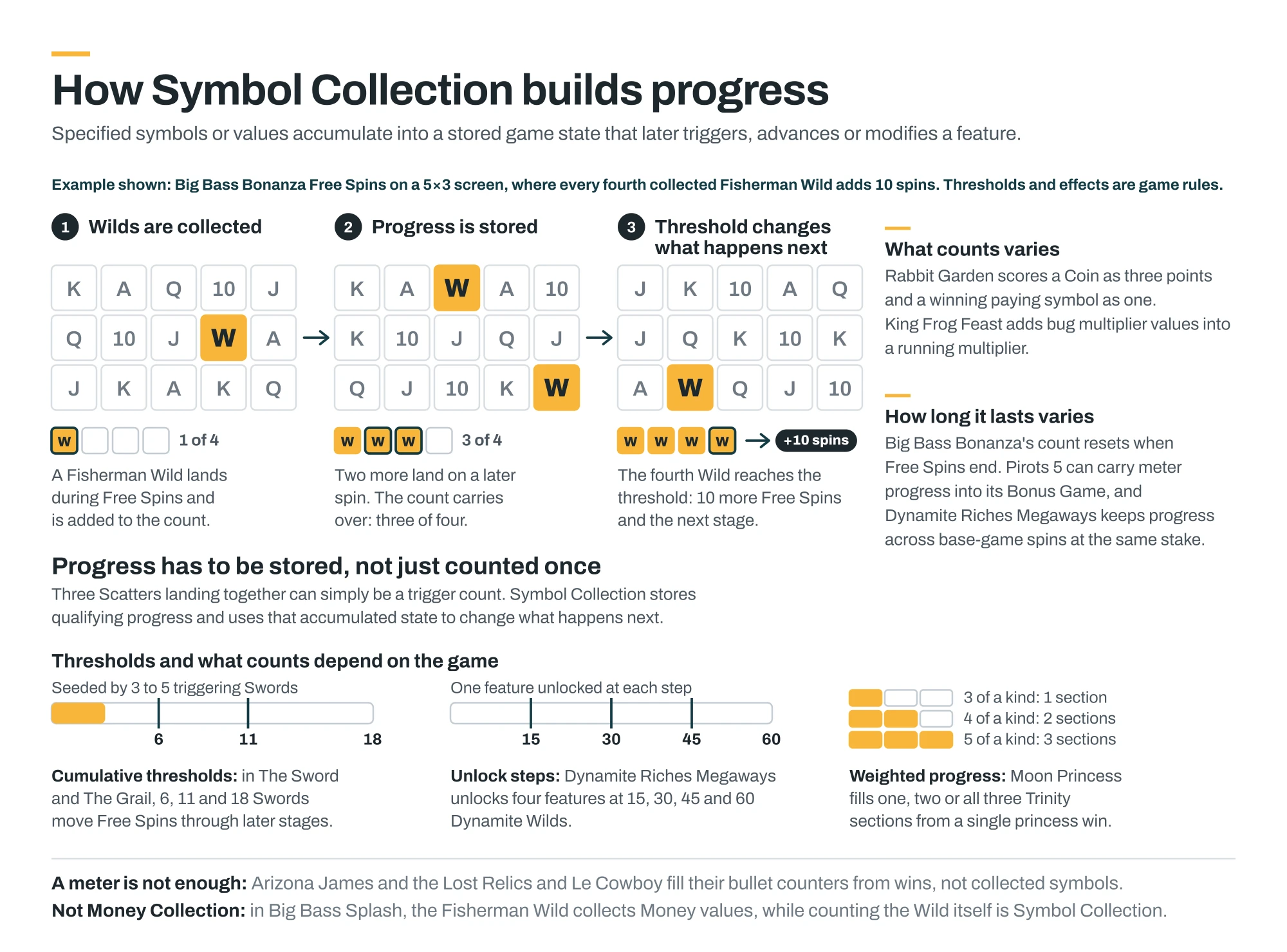
Big Bass Bonanza shows the idea neatly. Fisherman Wilds accumulate during Free Spins, with the 4th, 8th and 12th collected Wilds reaching the three progression stages. Dynamite Riches Megaways takes the same broad idea into the base game, where Dynamite Wilds feed a Feature Unlock Progress bar across spins at the same stake.
The useful ruleA symbol appearing is not enough. The defining question is whether the game accumulates specified symbols or values into a state that is later used to trigger, advance or modify something else.
How does Symbol Collection work?
One way to read any collection feature is to ask four questions: what is collected, where the progress is stored, what event or threshold changes the state, and what eventually resets or ends the collection.
Pirots 5 makes that sequence unusually visible. Its birds collect same-colour gems and eligible feature symbols, while eligible collected symbols also advance a Symbol Collection Meter. Filling that meter creates a pending feature-symbol release, and the collection-meter state can persist into the Bonus Game.
The Sword and The Grail uses cumulative Sword counts instead. Triggering Free Spins with three, four or five Swords seeds the starting count at that number. Reaching 6, 11 and 18 cumulative Swords advances through later stages, each with additional Free Spins and a stronger Grail Multiplier Wild state.
Both are collection mechanics, but they organise the progress very differently. One uses a named meter and a pending release; the other uses cumulative thresholds to move through a staged feature.
What can be collected?
The obvious answer is symbols, but even that covers several different behaviours. Some games count designated symbols directly, while others turn qualifying symbols or values into points, meter sections or another stored total.
Designated symbols
Big Bass Bonanza counts Fisherman Wilds. Dynamite Riches Megaways counts Dynamite Wild landings toward its unlock bar. The Sword and The Grail counts Swords through the first three Free Spins stages.
Weighted symbol progress
A collected symbol does not have to equal one unit of progress. In Moon Princess, qualifying princess-symbol wins fill a three-section Trinity meter: a three-of-a-kind fills one section, a four-of-a-kind fills two and a five-of-a-kind fills all three. In Rabbit Garden Free Spins, each winning paying symbol contributes one point while each collected Coin contributes three.
Values rather than raw symbol counts
Sometimes the game stores a value produced by the symbols rather than simply counting them. King Frog Feast, for example, adds fixed bug multiplier values into a running multiplier when the King Frog consumes those bugs. MONOPOLY Money Line uses a Collector that gathers visible symbol multipliers into its own persistent multiplier state during Free Spins.
Collection is about stateWhat gets collected can vary. The important part is that qualifying symbols or values are accumulated into a state that affects later game behaviour.
Where is collection progress stored?
Many games make collection obvious with a meter or progress bar, but that is a presentation choice rather than the mechanic itself.
Fat Banker uses an on-screen progress meter: each collected Wild Money Bag is added to it. Thor’s Rage 2 uses a three-level Thunder progress bar with three steps per level, with each Keeper Wild filling one step. Pirots 5 explicitly calls its system the Symbol Collection Meter.
Games do not all store progress in the same way. It may be a count, a stage, an unlocked-feature state or another persistent value.
That distinction matters because a meter alone does not prove Symbol Collection. The important question is what increments it. If the meter is driven by wins, duels or some other event rather than collected symbols or values, it belongs to a different progression model.
What can collection progress change?
What happens when the collection fills depends on the game. Reaching a threshold can alter very different parts of a slot.
In Big Bass Bonanza, every fourth collected Fisherman Wild awards 10 additional Free Spins, and the three collection stages also advance the separate Money-symbol collection multiplier from x1 to x2, x3 and x10. In Dynamite Riches Megaways, collection works as an unlock system: successive 15-Dynamite thresholds unlock TNT, Golden Wilds, Multiplier and Mega Wild features.
The Sword and The Grail uses collection to move through Free Spins stages. Pirots 5 can turn a filled collection meter into a pending feature-symbol release. In Viva Fiesta, collecting coloured Skull Coins can unlock one, two or all three minigames.
So “collection” tells you how progress builds, not what the eventual effect has to be.
How long can collection progress last?
How long the progress lasts is one of the biggest differences between collection systems. Some reset when a bonus ends. Others survive several stages, carry into another feature state or remain active across base-game spins.
Big Bass Bonanza keeps its accumulated Fisherman Wild count through the Free Spins round and resets when that feature ends. The Sword and The Grail carries its cumulative Sword total through the first three Free Spins stages before collection stops at 18 Swords.
Pirots 5 can carry collection-meter progress into its Bonus Game. Dynamite Riches Megaways goes further: its Dynamite collection can persist in the base game at the same stake until all four features have been unlocked.
Do not assume the resetA collection meter can last for one feature, several feature stages or much longer. The reset rule has to come from the game’s own evidence.
Symbol Collection examples compared
| Game | What is collected | Stored progress | What the collection changes |
|---|---|---|---|
| Pirots 5 | Eligible symbols collected during CollectR play. | Symbol Collection Meter; state can persist into the Bonus Game. | A full meter creates a pending feature-symbol release. |
| Big Bass Bonanza | Fisherman Wilds during Free Spins. | Cumulative Wild count through the feature. | Every fourth Wild adds 10 Free Spins; stages also advance the Money-collection multiplier to x2, x3 and x10. |
| Dynamite Riches Megaways | Dynamite Wild landings. | Feature Unlock Progress at the same stake. | 15 / 30 / 45 / 60 Dynamites unlock four successive features. |
| The Sword and The Grail | Cumulative Sword symbols, seeded by the triggering Swords. | Sword count through Free Spins stages 1 to 3. | Thresholds at 6 / 11 / 18 Swords advance stages, add spins and change Grail multiplier state. |
| Moon Princess | Qualifying princess-symbol winning combinations. | Three-section Princess Trinity meter. | In base play, a full meter awards one Princess Trinity free round. During Free Spins, filling the meter adds spins instead; Princess Trinity itself is inactive. |
| Fat Banker | Wild Money Bags during Fat Banker Free Spins. | On-screen progress meter through the feature. | Defined thresholds grow the Banker and add Free Spins; the first growth step needs five additional bags and awards three extra Free Spins. |
| Viva Fiesta | Coloured Skull Coins. | Persistent coin-collection state until the feature sequence resolves. | Collecting the coloured coins can unlock one, two or all three minigames; the exact colour mapping is not stated in the evidence used here. |
Symbol Collection vs Money Collection
The terminology is easy to muddle because both mechanics can be described as “collecting”. They are not the same thing.
Money Collection is about gathering monetary or prize values from eligible symbols when a collector event occurs. Symbol Collection is about storing qualifying symbols, counts or values as progression that later changes another game state.
Big Bass Splash shows both behaviours in the same feature. When a Fisherman Wild lands, it collects the Money values visible on the screen. That is Money Collection. The Fisherman Wild itself is also counted toward a separate progression ladder, where every fourth collected Wild retriggers 10 Free Spins and advances the collection multiplier. That second state is Symbol Collection.
Same word, different jobCollecting visible prize values and collecting symbols toward a later threshold can happen in the same game. They are still different mechanics.
Symbol Collection vs Scatter and Bonus trigger counts
Landing or collecting a required number of trigger symbols does not automatically create a Symbol Collection mechanic. A normal Scatter or Bonus trigger can be evaluated in one result without the game storing progress from earlier results.
Concrete Cowboys marks the boundary. Its rules say collecting three Bonus symbols triggers the Bonus game with five bonus drops at the current grid size. That establishes the trigger, but it does not by itself establish a persistent cross-result Symbol Collection state. The three-symbol trigger is therefore separate from the game’s broader CollectR behaviour.
The practical test is whether progress is stored and carried forward. If three symbols simply satisfy a trigger condition together, that is a trigger count. If qualifying symbols accumulate into state that survives and later changes the game, that is the collection behaviour this page is describing.
Symbol Collection vs win-driven meters and counters
A feature can have a counter called a “Collector” without collecting symbols at all. The input to the counter matters more than the label on the interface.
In Arizona James and the Lost Relics, each regular win during Tomb of Gold adds one bullet to the Bullet Collector. Le Cowboy uses the same broad idea in Trail of Trickery: each win adds one bullet. Those are win-driven counters, because wins increase the stored count rather than designated symbols being collected into it.
Death Becomes You gives another version. Its Drop Dead feature displays defeated Monsters on a Duel Counter, and defeating five Monsters awards Duel with Death. Again, the stored progression comes from duel outcomes rather than collected symbols.
These examples show why the word “collector” is not enough to define the mechanic.
Symbol Collection vs Hold & Win
Hold & Win or money-respin features usually revolve around positions or symbols being retained while a respin counter resets. Retaining those symbols is not automatically Symbol Collection.
Monopoly Megapots illustrates the overlap. During Hold and Spin, matching Megapots icons can accumulate toward a three-icon prize trigger. That collection sits inside a held-position respin feature, but the Hold and Spin system itself is a separate mechanic. It is a boundary example rather than a defining example of Symbol Collection.
A slot can use both ideas at once: held positions define the respin structure, while a separate collection rule may count or match symbols inside it.
What the Symbol Collection label does not tell you
Knowing that a slot uses Symbol Collection still leaves plenty unanswered: whether progress is shown on a meter, whether every symbol is worth one point, how many thresholds exist, what happens at each threshold and when the collection resets.
It also tells you nothing by itself about RTP, volatility, hit frequency, feature frequency, maximum win or the likelihood of winning. The presence of a collection meter is not evidence that a feature is easier to reach or that the game offers better value.
Collection can interact with Free Spins and Increasing Multipliers, but those are separate mechanics. Big Bass Bonanza is a good example: collected Wilds advance the feature, while a separate multiplier state changes at the collection thresholds.
Symbol Collection FAQ
What are Symbol Collection slots?
They are slots where specified symbols or values are collected and stored by the game, then used to trigger, advance or modify another feature or game state.
How do Symbol Collection features work?
The game decides what counts toward the collection, stores that progress, then uses a threshold or other state rule to change something later. The collected item, persistence, effect and reset are game-specific.
What counts as a collected symbol?
Only the symbols or values the game’s rules say contribute to the collection. In some games that is a direct symbol count; in others, qualifying symbols contribute different numbers of points or meter sections.
Does Symbol Collection always use a meter?
No. A visible meter or progress bar is common, but collection can also be stored as a count, stage, unlocked-feature state or another persistent value.
What can happen when a collection threshold is reached?
Depending on the game, a threshold can add Free Spins, advance a feature stage, unlock another feature, release feature symbols, alter a multiplier state or unlock a minigame.
Does collection progress persist between spins or bonus stages?
It can. Big Bass Bonanza keeps its Wild count through Free Spins, Pirots 5 can carry meter progress into its Bonus Game, and Dynamite Riches Megaways can retain unlock progress across base-game spins at the same stake.
What is the difference between Symbol Collection and Money Collection?
Symbol Collection stores symbols, counts or values as progression toward a later state change. Money Collection gathers monetary or prize values from eligible symbols when a collector event occurs. A game can use both.
Is collecting three Scatter or Bonus symbols the same as Symbol Collection?
Not necessarily. If the symbols simply satisfy a trigger condition together, that is a trigger count. Symbol Collection requires evidence that qualifying symbols or values are accumulated into progress that carries forward.
What is the difference between Symbol Collection and a win-driven meter?
Symbol Collection is driven by specified collected symbols or values. A win-driven meter advances from wins or other outcomes instead, even if the game calls the counter a Collector.
Is Symbol Collection the same as Hold & Win?
No. Hold & Win describes a held-position respin structure. A collection rule can operate inside that structure, but retaining symbols and counting collected progress are separate behaviours.
Sources reviewed
The examples on this page were checked against primary material wherever possible. Linked game names below lead to the software provider’s public game page where available. The evidence reviewed may also include in-game rules, developer game sheets and authenticated developer material that is not publicly accessible.
ELK Studios
Pragmatic Play / Reel Kingdom
Red Tiger
Play’n GO
Push Gaming
Red Rake Gaming
Habanero
Hacksaw Gaming
NetEnt
Big Time Gaming
How we research slot mechanics
Slotathon starts with primary evidence such as game rules, in-game help, developer documentation and game sheets. Third-party reviews are used as secondary sources to compare against that evidence and help identify areas that may need further verification.
When sources disagree, we preserve the disagreement in the research instead of quietly choosing whichever version is easiest to publish.