
Cluster Pays Slots: How Cluster Wins Work
Cluster Pays replaces fixed line paths with connected groups of matching symbols. The simple idea is that matching symbols connect side-to-side, but the exact cluster size and connection rule still depend on the game.
Quick answerIn a Cluster Pays slot, matching symbols form a win by making a qualifying connected group rather than by landing on a fixed payline. In the games Slotathon reviewed for this page, qualifying symbols connect horizontally or vertically by their sides. The minimum cluster size varies by game.
What is Cluster Pays?
Cluster Pays looks for matching symbols that connect side-to-side to form a group. There is no predefined line to follow, so a winning cluster can bend around the grid rather than tracing a straight or zig-zag route.
That separates it from Fixed Paylines, where the game evaluates specific line paths, and from Ways to Win, where matching symbols form combinations across qualifying consecutive reels.
You will often see Cluster Pays grouped under grid slots. That is useful shorthand, but it is not a definition. The grid describes the layout; Cluster Pays describes how a winning group is formed.
How does a cluster win work?
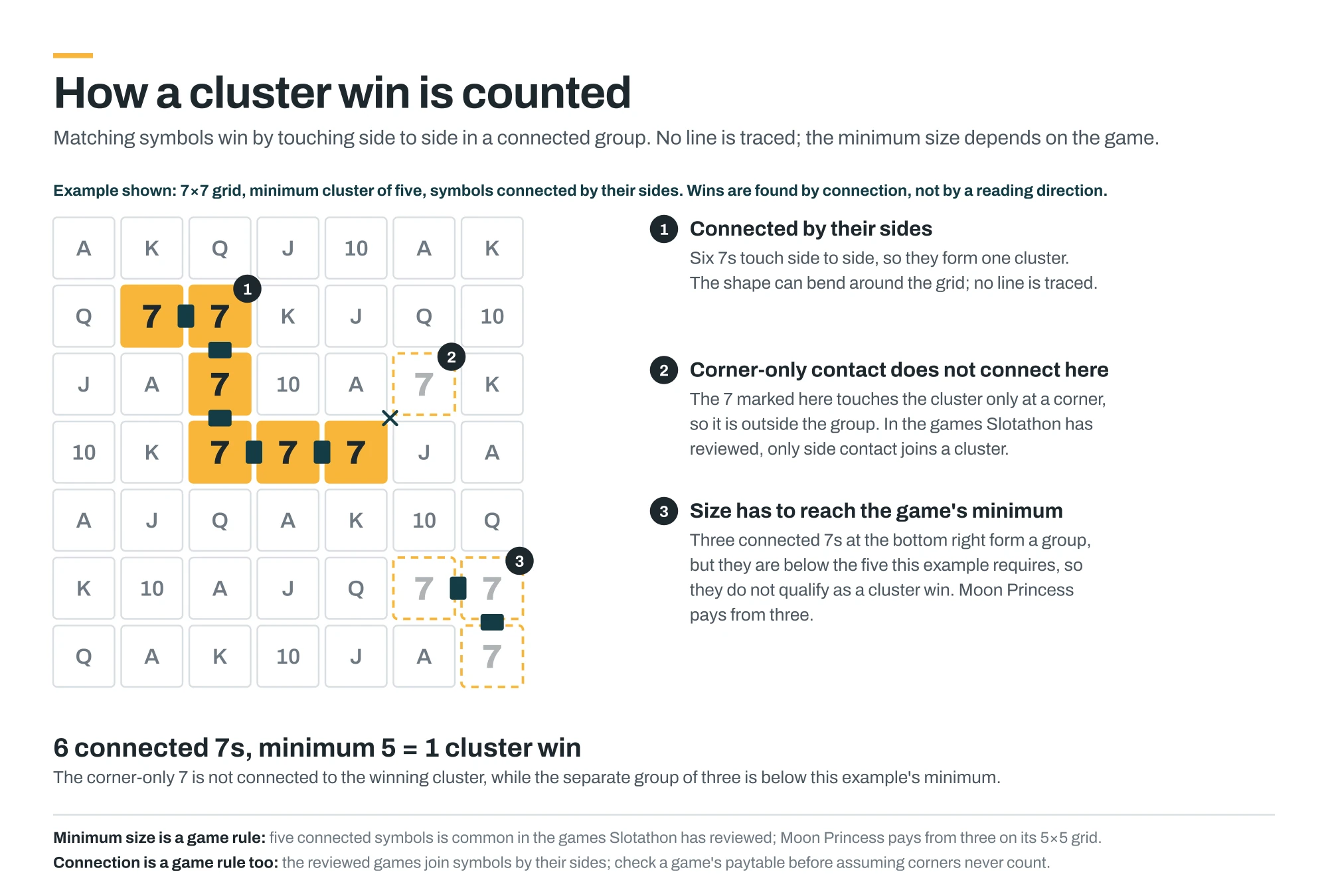
Start with one matching symbol, then look at the positions directly beside it. If another matching symbol touches one of its sides, it can join the same cluster. The group can keep spreading up, down, left or right as more matching symbols connect.
Rabbit Garden shows the rule clearly. It uses a 7×7 grid and requires at least five matching paying symbols to be connected horizontally or vertically. A qualifying group can form anywhere on the grid.
The shape itself does not have to be tidy. A cluster might look like a block, a corner or an uneven chain of symbols. What matters is whether the game’s connection rule keeps the matching symbols joined.
Do diagonal symbols count in Cluster Pays?
Not automatically.
Across the games reviewed for this page, cluster connections use horizontal or vertical side contact. Rabbit Garden makes the boundary especially clear: diagonal-only contact does not join the winning cluster.
Connection ruleSide-by-side contact joins the cluster in the reviewed examples. A matching symbol that only touches at a corner is outside the group unless that particular game’s rules say otherwise.
For a specific title, check the paytable or help screen rather than assuming every Cluster Pays game treats corners the same way.
How many symbols make a winning cluster?
There is no universal minimum.
Five matching symbols is common in the games Slotathon reviewed, but it is not the definition of Cluster Pays. Moon Princess shows why: its rules allow a winning cluster from just three matching symbols connected horizontally or vertically on its 5×5 grid.
| Game | Grid | Verified minimum | Connection rule |
|---|---|---|---|
| Moon Princess | 5×5 | 3 matching symbols | Horizontal or vertical |
| Sugar Rush | 7×7 | 5 matching symbols | Horizontal or vertical |
| Rabbit Garden | 7×7 | 5 matching symbols | Horizontal or vertical |
| Reactoonz | 7×7 | 5 matching symbols | Horizontal or vertical |
| Propaganda | 6×6 | 5 matching symbols | Horizontal or vertical |
So five or more is common in the games Slotathon reviewed, not a universal Cluster Pays rule.
Does the grid size matter?
There is no standard Cluster Pays grid size.
Slotathon’s reviewed examples include Moon Princess on 5×5, Propaganda on 6×6, and both Sugar Rush and Reactoonz on 7×7.
Those layouts can make the games look quite different from a traditional 5×3 slot, but the payout model is still defined by connected matching symbols, not by a particular number of rows or columns.
Cluster Pays vs Cascading Reels
These mechanics often appear together, which makes them easy to blur into one idea. They do different jobs.
Cluster Pays decides whether the visible symbols form a win. Cascading Reels describes what happens after a winning set of symbols is resolved, such as removing those symbols and allowing replacements to fall into the empty spaces.
Sugar Rush shows the distinction neatly. Five or more matching symbols connected horizontally or vertically form a winning cluster. Its separate Tumble Feature then removes the winning symbols, drops the remaining symbols and fills the empty positions with new ones.
Reactoonz and Moon Princess also combine cluster wins with cascading behaviour. That pairing is common in the reviewed examples, but a cascade is not what makes the payout system Cluster Pays.
Cluster Pays vs Fixed Paylines vs Ways to Win vs Pay Anywhere
A useful way to separate these systems is to ask what relationship the matching symbols need to have.
| Payout system | What creates the winning arrangement? |
|---|---|
| Cluster Pays | Matching symbols form a qualifying connected group. |
Fixed Paylines |
Matching symbols occupy positions on one of the game’s predefined line paths. |
Ways to Win |
Matching symbols form combinations across qualifying consecutive reels without a fixed line path. |
Pay Anywhere |
A qualifying number of matching symbols can pay by count without needing to form a connected cluster. |
Connectivity is the key boundary for Cluster Pays. Two groups can contain the same number of matching symbols, but if one group is connected and the other is scattered around the grid, they are not equivalent under a cluster rule.
What Cluster Pays does not tell you
Knowing that a game uses Cluster Pays tells you how one type of winning arrangement is recognised. It does not tell you the game’s broader mathematical profile.
Cluster Pays alone does not establish:
- RTP;
- volatility;
- hit frequency;
- maximum win;
- how often a bonus appears;
- whether the game is more likely to produce a win than another payout system.
Those properties need their own evidence. A larger grid or a lower cluster threshold does not, on its own, make a game more favourable.
Cluster Pays FAQ
What is Cluster Pays in slots?
Cluster Pays is a payout system where matching symbols form a qualifying connected group rather than following a predefined payline.
How many symbols are needed for a cluster win?
It depends on the game. Moon Princess pays from 3 matching symbols, while Sugar Rush, Rabbit Garden, Reactoonz and Propaganda require at least 5.
Do diagonal symbols count in Cluster Pays?
Not automatically. The reviewed games on this page use horizontal or vertical side contact. Rabbit Garden explicitly requires that form of connection, so diagonal-only contact does not join the cluster there. Check the individual game’s rules for its connection rule.
Is Cluster Pays the same as Cascading Reels?
No. Cluster Pays determines whether a connected symbol group qualifies as a win. Cascading Reels describes the post-win replacement process used by some games.
What is the difference between Cluster Pays and Ways to Win?
Cluster Pays requires a connected group of matching symbols. Ways to Win instead evaluates matching symbols across qualifying consecutive reels.
What is the difference between Cluster Pays and Pay Anywhere?
Cluster Pays requires matching symbols to form a connected group. Pay Anywhere can award qualifying matching symbols by count without requiring them to touch.
Are all grid slots Cluster Pays?
No. A grid describes the shape of the playing area. The payout rules determine whether a game is Cluster Pays, Ways to Win, Pay Anywhere or another system.
Sources reviewed
The examples on this page were checked against primary material wherever possible. Linked game names below lead to the software provider’s public game page. The evidence reviewed may also include in-game rules, developer game sheets and authenticated developer material that is not publicly accessible.
ELK Studios
In-game rules and paytable, ELK Studios product and game data sheets, and official game page.
Play’n GO
Play’n GO rules PDF, supplied gameplay material and official game page.
Play’n GO rules PDF, supplied in-game rules and gameplay material, and official game page.
Pragmatic Play
Current in-game rules, Pragmatic Play game overview and structured game data,
GLI UK certification and official game page.
Current in-game rules, Pragmatic Play game overview and structured game data,
GLI UK certification and official game page.
The linked game names above point to public developer game pages where available.
Some of the underlying evidence used by Slotathon is only available in-game or through
authenticated developer and client systems. Slotathon records those sources and the
claims they support in its research database but does not republish restricted material.
How we research slot mechanics
Slotathon starts with primary evidence such as game rules, in-game help, developer documentation and game sheets. Third-party reviews are used as secondary sources to compare against that evidence and help identify areas that may need further verification.
When sources disagree, we preserve the disagreement in the research instead of quietly choosing whichever version is easiest to publish.